Question 14 Marks
- A ray of light is incident normally on the face AB of a right-angled glass prism of refractive index $_{a}\mu_{g} =1.5$The prism is partly immersed in a liquid of unknown refractive index. Find the value of refractive index of the liquid so that the ray grazes along the face BC after refraction through the prism.
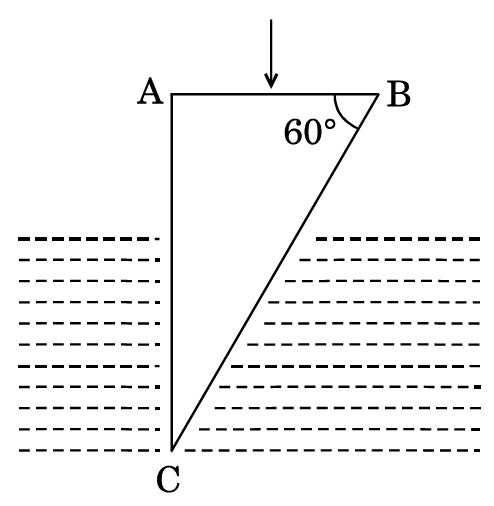
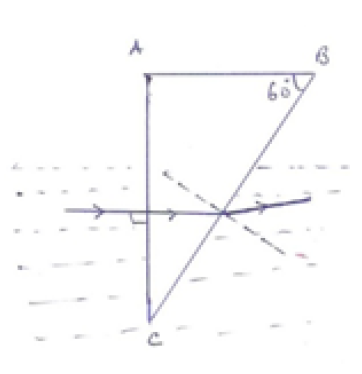
- Trace the path of the rays if it were incident normally on the face AC.
Answer
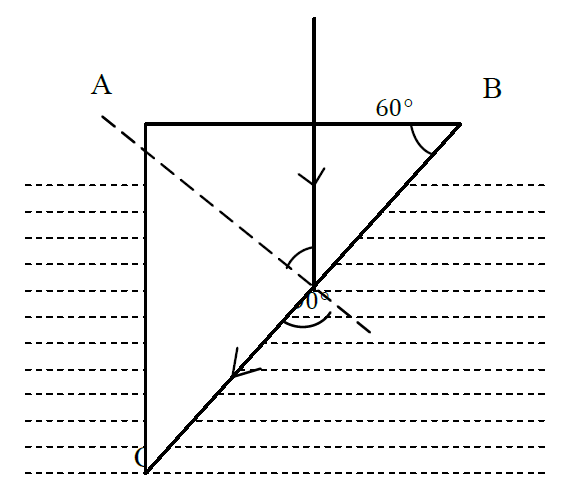
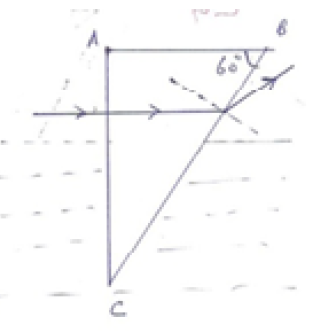
View full question & answer→ $\sin\text{i}_{c} = \frac{1}{\mu}_{mg} = \frac{\mu_m}{\mu_{g}}$
$\Rightarrow \mu_{m} = \mu_{g}\sin\text{i}_{c}$
$=1.5\times \frac{\sqrt{3}}{2}(\text{i}_{c} = 60^{\circ})$
$ = 1.299 \simeq1.3$
Alternate Answer