A concave lens has a focal length of 20cm. At what distance from the lens a 5cm tall object be placed so that it forms an image at 15cm from the lens? Also calculate the size of the image formed.
Download our app for free and get started
f = -20cm $h _1=5 cm$ v = -15cm (Concave lens forms virtual image)$\frac{1}{\text{v}}-\frac{1}{\text{u}}=\frac{1}{\text{f}}$
$\frac{1}{-15}-\frac{1}{\text{u}}=\frac{1}{-20}$
$\frac{1}{\text{u}}=-\frac{1}{15}+\frac{1}{20}$
$\frac{1}{\text{u}}=\frac{-1}{60}$
$\text{u}=-60\text{cm}$
Object should be placed 60cm to the left of the lens.$\text{m}=\frac{\text{v}}{\text{u}}=\frac{\text{h}_2}{\text{h}_1}$
$\frac{-15}{-60}=\frac{\text{h}_2}{\text{h}_1}$
$\frac{-15}{-60}=\frac{\text{h}_2}{5}$
$\text{h}_2=1.25\text{cm}$
Image formed is 1.25cm high.
$\frac{1}{-15}-\frac{1}{\text{u}}=\frac{1}{-20}$
$\frac{1}{\text{u}}=-\frac{1}{15}+\frac{1}{20}$
$\frac{1}{\text{u}}=\frac{-1}{60}$
$\text{u}=-60\text{cm}$
Object should be placed 60cm to the left of the lens.$\text{m}=\frac{\text{v}}{\text{u}}=\frac{\text{h}_2}{\text{h}_1}$
$\frac{-15}{-60}=\frac{\text{h}_2}{\text{h}_1}$
$\frac{-15}{-60}=\frac{\text{h}_2}{5}$
$\text{h}_2=1.25\text{cm}$
Image formed is 1.25cm high.

Download our appand get started for free
Experience the future of education. Simply download our apps or reach out to us for more information. Let's shape the future of learning together!No signup needed.*
Similar Questions
- 1View SolutionThe two rays chosen for the construction of ray diagram is:
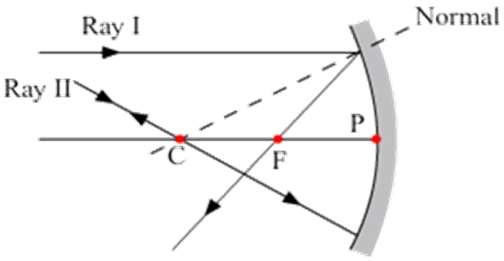
Ray 1: When the incident ray is parallel to the principal axis, the reflected ray will pass through the focus of concave mirror or it appears to pass through the focus of convex mirror.
Ray 2: When the incident ray passes through or appears to pass through the centre of curvature, the light, after reflection from the spherical mirror, reflects back along the same path.
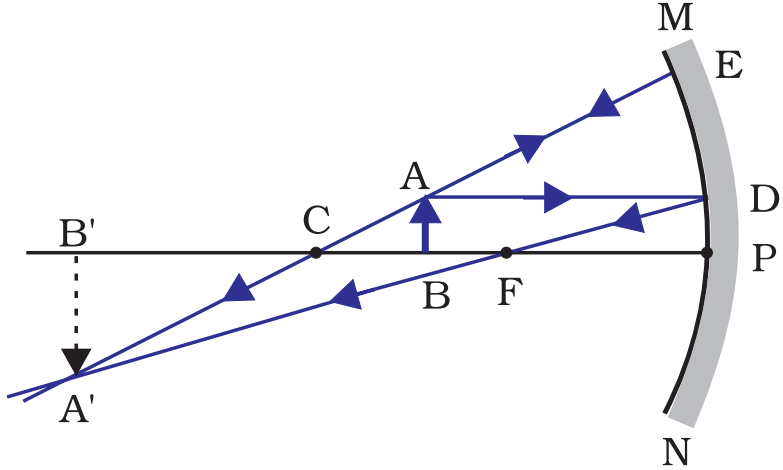
The image formed is real, inverted, magnified and is formed beyond the centre of curvature.
- 2View SolutionDescribe an activity to show that the colours of white light splinted by a glass prism can be recombined to get white light by another identical glass prism. AIso draw ray diagram to show the recombination of the spectrum of white light.
- 3View SolutionA 4 cm tall object is placed perpendicular to the principal axis of a convex lens of focal length 24 cm. The distance of the object from the lens is 16 cm. Find the position, size and nature of the image formed, using the lens formula.
- 4View SolutionThe image of a candle flame placed at a distance of 30 cm from a mirror is formed on a screen placed in front of the mirror at a distance of 60 cm from its pole. What is the nature of the mirror? Find its focal length. If the height of the flame is 2.4 cm, find the height of its image. State whether the image formed is erect or inverted.
- 5View SolutionFind the position and nature of the image of an object 5cm high and 10cm in front of a convex lens of focal length 6cm.
- 6View SolutionA concave lens of focal length 15 cm forms an image 10 cm from the lens. How far is the object placed from the lens? Draw the ray diagram.
- 7View SolutionGive three examples of materials that refract light rays. What happens to the speed of light rays when they enter these materials?
- 8View Solution
- Draw a ray diagram to show the refraction of light through a glass slab and mark angle of refraction and the lateral shift suffered by the ray of light while passing through the slab.
- If the refractive index of glass for light going from air to glass is 3/2, find the refractive index of air for light going from glass to air.
- 9View SolutionState the laws of refraction of light. Explain the term ‘absolute refractive index of a medium’ and write an expression to relate it with the speed of light in vacuum.
- 10View SolutionWhich mirror is used as a torch reflector? Draw a labelled diagram to show how a torch reflector can be used to produce a parallel beam of light. Where is the bulb placed in relation to the torch reflector?