Describe an activity to show that the colours of white light splinted by a glass prism can be recombined to get white light by another identical glass prism. AIso draw ray diagram to show the recombination of the spectrum of white light.
CBSE OUTSIDE DELHI - SET 1 2016
Download our app for free and get started
Different colors of light bend through different angles with respect to the incident ray as they pass through a prism. The red light bends the least, while the violet bends the most. Thus, the rays of each colour emerge along different paths and thus become distinct. This is the cause of dispersion of white light passing through a glass prism.
Isaac Newton used two glass primes, with one prism in inverted position to show that white light of the Sun contains seven colors. The set-up has been shown below:
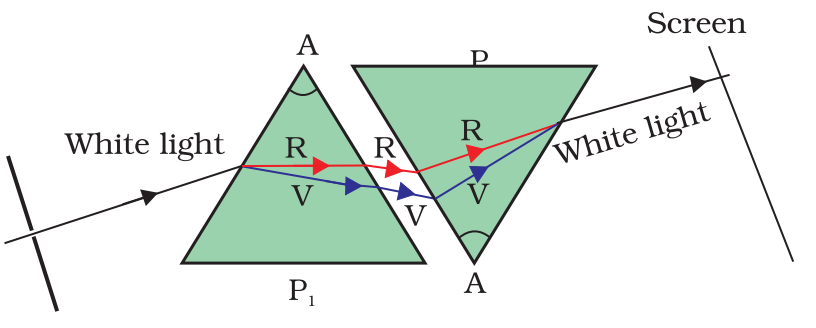
When white light of the Sun passes through the first prism, it gets dispersed into seven colors. When all the seven colors of the spectrum were passed through the second prism, Newton found a beam of white light emerging from the other side of the second prism. This observation gave Newton the idea that the sunlight is made up of seven colors.

Download our appand get started for free
Experience the future of education. Simply download our apps or reach out to us for more information. Let's shape the future of learning together!No signup needed.*
Similar Questions
- 1View SolutionA magnifying lens has a focal length of 100mm. An object whose size is 16mm is placed at some distance from the lens so that an image is formed at a distance of 25cm in front of the lens.
- What is the distance between the object and the lens?
- Where should the object be placed if the image is to form at infinity?
- 2View SolutionAn erect image 2.0cm high is formed 12cm from a lens, the object being 0.5cm high. Find the focal length of the lens.
- 3View SolutionHow far should an object be placed from a convex lens of focal length 20cm to obtain its image at a distance of 30cm from the lens? What will be the height of the image, if the objects is 6cm tall?
- 4View SolutionDefine 'refractive index of transparent medium'. What is its unit? Which has a higher refractive index, glass or water?
- 5View SolutionA dentist uses a mirror in front of a decayed tooth at a distance of 4cm from the tooth to get four times magnified image in the mirror. Use mirror formula to find the focal length and nature of the mirror used.
- 6View SolutionWhat can you see in a completely dark room? If you switch on an electric bulb in this dark room as a light source, explain how you could now see:
- The electric bulb.
- A piece of white paper.
- 7View SolutionTwo lenses have powers of (i) +2D and (ii) -4D. What is the nature and focal length of each lens?
- 8View SolutionDraw a diagram to show how a converging lens held close to the eye acts as a magnifying glass. Why is it usual to choose a lens of short focal length for this purpose rather than one of long focal length?
- 9View SolutionTo construct a ray diagram we use two rays of light which are so chosen that it is easy to determine their directions after reflection from the mirror. Choose these two rays and state the path of these rays after reflection from a concave mirror. Use these two rays to find the nature and position of the image of an object placed at a distance of 15cm from a concave mirror of focal length 10cm.
- 10View SolutionIf the image formed by a lens for all positions of the object placed in front of it is always virtual, erect and diminished, state the type of the lens. Draw a ray diagram in support of your answer. If the numerical value of focal length of such a lens is 20 cm, find its power in new cartesian sign conventions.