Question
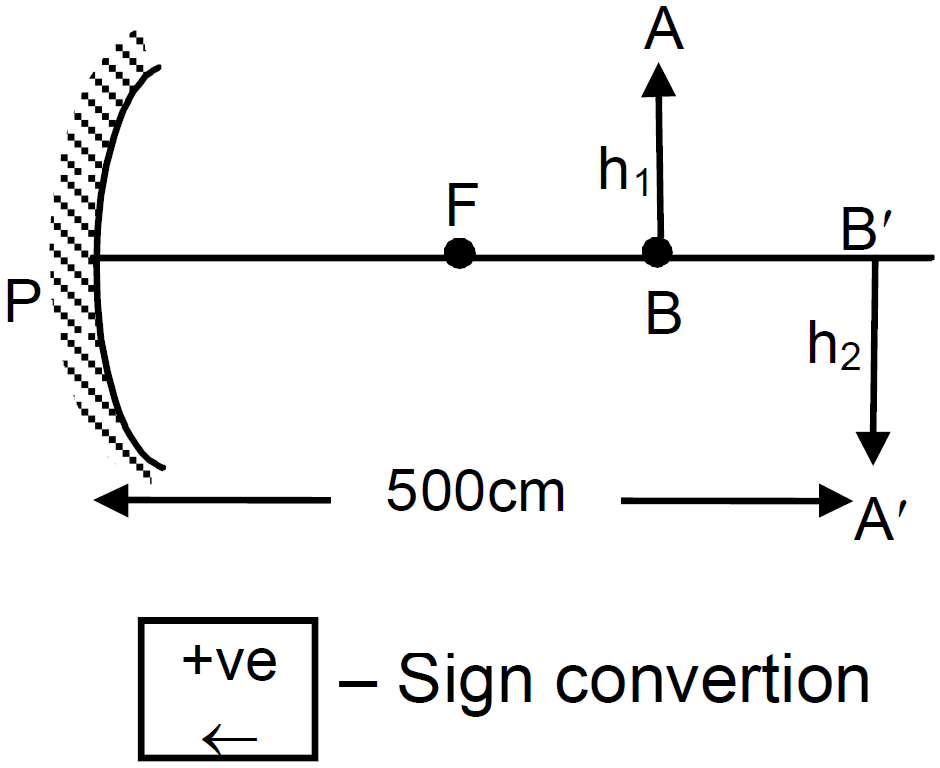
A concave mirror forms an image of $20cm$ high object on a screen placed $5.0m$ away from the mirror. The height of the image is $50cm$. Find the focal length of the mirror and the distance between the mirror and the object.
Answer


Given that, $H_1 = 20cm, v = -5m = -500cm, h_2 = 50cm$ Since, $\frac{-\text{v}}{\text{u}}=\frac{\text{h}_2}{\text{h}_1}$ or $\frac{500}{\text{u}}=-\frac{50}{20}$ (because the image in inverted) or $\text{u}=-\frac{500\times2}{5}=-200\text{cm}=-2\text{m}$$\frac{1}{\text{v}}+\frac{1}{\text{u}}=\frac{1}{\text{f}}$ or $\frac{1}{-5}+\frac{1}{-2}=\frac{1}{\text{f}}$
or $\text{f}=\frac{-10}{7}=-1.44\text{m}$ So, the focal length is 1.44m.

Need a full question paper?

Generate a complete, print-ready paper with questions like this in minutes — across 16+ boards, with answer keys.
Start Generating Free

Similar questions

Compute the bulk modulus of water from the following data: Initial volume = $100.0$ litre, Pressure increase = 100.0 atm ($1\ atm = 1.013 × 10⁵ Pa$), Final volume = $100.5$ litre. Compare the bulk modulus of water with that of air (at constant temperature). Explain in simple terms why the ratio is so large.
There are three forces $F_1, F_2$ and $F_3$ acting on a body, all acting on a point P on the body. The body is found to move with uniform speed.
  1. Show that the forces are coplanar.
  2. Show that the torque acting on the body about any point due to these three forces is zero.
The illuminance of a small area changes from $900\ lumen/m^2$ to $400\ lumen/m^2$ when it is shifted along its normal by $10cm$. Assuming that it is illuminated by a point source placed on the normal, find the distance between the source and the area in the original position.
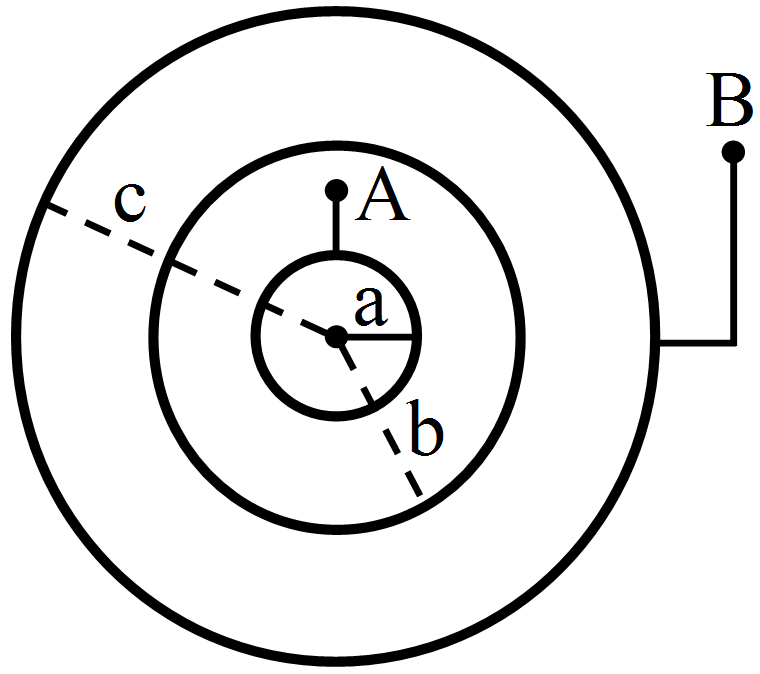
Consider an assembly of three conducting concentric spherical shells of radii a, b and c as shown in figure. Find the capecitance of the assembly between the poima A and B
Glycerine flows steadily through a horizontal tube of length $1.5m$ and radius $1.0cm$. If the amount of glycerine collected per second at one end is $4.0 \times 10^{–3}kg s^{–1}$, what is the pressure difference between the two ends of the tube? (Density of glycerine $= 1.3 \times 103kg m^{–3}$ and viscosity of glycerine = $0.83 Pa$). [You may also like to check if the assumption of laminar flow in the tube is correct].
Three particles of masses 1.0kg, 2.0kg and 3.0kg are placed at the corners A, B and C respectively of an equilateral triangle ABC of edge 1m. Locate the centre of mass of the system.
A small block of mass m and a concave mirror of radius R fitted with a stand lie on a smooth horizontal table with a separation d between them. The mirror together with its stand has a mass m. The block is pushed at $t = 0$ towards the mirror so that it starts moving towards the mirror at a constant speed V and collides with it. The collision is perfectly elastic. Find the velocity of the image:
  1. At a time $\text{t}<\frac{\text{d}}{\text{V}}$
  2. At a time $\text{t}>\frac{\text{d}}{\text{V}}.$
Establish the following vector inequalities geometrically or otherwise: $|\text{a}+\text{b}|\le|\text{a}|+|\text{b}|$ When does the equality sign above apply?
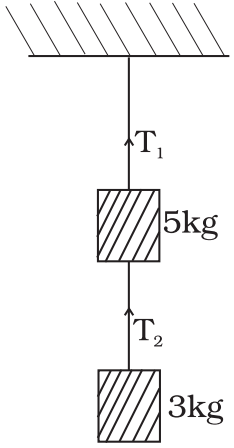
Two masses of 5 kg and 3 kg are suspended with help of massless inextensible strings as shown in Calculate $\mathrm{T}_1$ and $\mathrm{T}_2$ when whole system is going upwards with acceleration $=2 \mathrm{~m} \mathrm{~s}^2\left(\mathrm{use} \mathrm{~g}=9.8 \mathrm{~m} \mathrm{~s}^{-2}\right)$.
A voltmeter coil has resistance $50.0\Omega$ and a resistor of $1.15\text{k}\Omega$ is connected in series. It can read potential differences up to 12 volts. If this same coil is used to construct an ammeter that can measure currents up to 2.0A, what should be the resistance of the shunt used?