Three particles of masses 1.0kg, 2.0kg and 3.0kg are placed at the corners A, B and C respectively of an equilateral triangle ABC of edge 1m. Locate the centre of mass of the system.
Download our app for free and get started
$\text{m}_1=1\text{kg},\ \text{m}_2=2\text{kg},\ \text{m}_3=3\text{kg}$ $\text{x}_1=0,\ \text{x}_2=1,\ \text{x}_3=\frac{1}{2}$ $\text{y}_1=0,\ \text{y}_2=0,\ \text{y}_3=\frac{\sqrt3}{2}$ 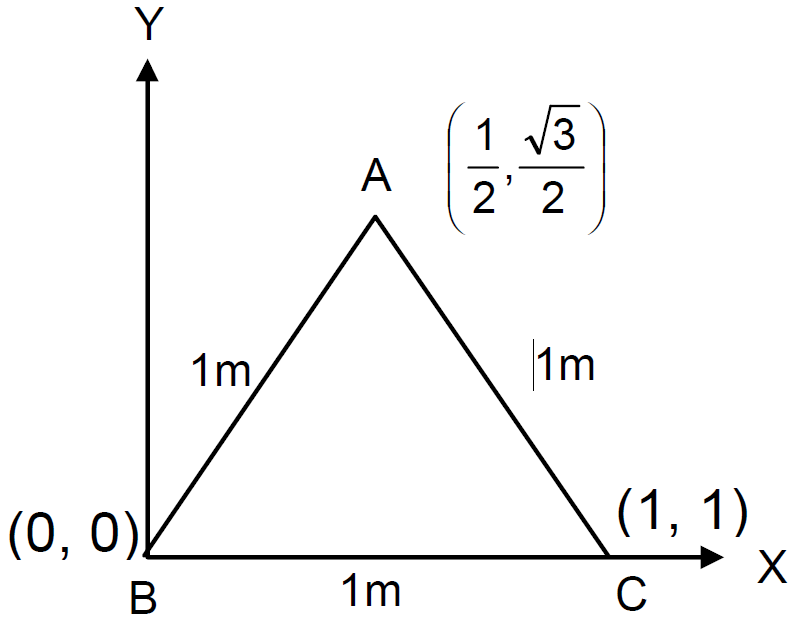 The position of centre of mass is, $\text{CM}=\Big(\frac{\text{m}_1\text{x}_1+\text{m}_2\text{x}_2+\text{m}_3\text{x}_3}{\text{m}_1+\text{m}_2+\text{m}_3},\frac{\text{m}_1\text{y}_1+\text{m}_2\text{y}_2+\text{m}_3\text{y}_3}{\text{m}_1+\text{m}_2+\text{m}_3}\Big)$ $=\Bigg(\frac{(1\times0)+(2\times1)\big(3\times\frac{1}{2}\big)}{1+2+3},\frac{(1\times0)+(2\times0)+\big(3\times\frac{\sqrt3}{2}\big)}{1+2+3}\Bigg)$ $=\Big(\frac{7}{12},\frac{3\sqrt3}{12}\Big)$ from the point B.
The position of centre of mass is, $\text{CM}=\Big(\frac{\text{m}_1\text{x}_1+\text{m}_2\text{x}_2+\text{m}_3\text{x}_3}{\text{m}_1+\text{m}_2+\text{m}_3},\frac{\text{m}_1\text{y}_1+\text{m}_2\text{y}_2+\text{m}_3\text{y}_3}{\text{m}_1+\text{m}_2+\text{m}_3}\Big)$ $=\Bigg(\frac{(1\times0)+(2\times1)\big(3\times\frac{1}{2}\big)}{1+2+3},\frac{(1\times0)+(2\times0)+\big(3\times\frac{\sqrt3}{2}\big)}{1+2+3}\Bigg)$ $=\Big(\frac{7}{12},\frac{3\sqrt3}{12}\Big)$ from the point B.
Download our appand get started for free
Experience the future of education. Simply download our apps or reach out to us for more information. Let's shape the future of learning together!No signup needed.*
Similar Questions
- 1A uniform sphere of mass m and radius R is placed on a rough horizontal surface. The sphere is struck horizontally at a height h from the floor. Match the following:View Solution
a. $\text{h}=\frac{\text{R}}{2}$ i. Sphere rolls without slipping with a constant velocity and no loss of energy. b. $\text{h}=\text{R}$ ii. Sphere spins clockwise, loses energy by friction. c. $\text{h}=\frac{3\text{R}}{2}$ iii. Sphere spins anti-clockwise, loses energy by friction. d. $\text{h}=\frac{7\text{R}}{5}$ iv. Sphere has only a translational motion, looses energy by friction. - 2From a uniform disk of radius R, a circular hole of radius $\frac{\text{R}}{2}$ is cut out. The centre of the hole is at $\frac{\text{R}}{2}$ from the centre of the original disc. Locate the centre of gravity of the resulting flat body.View Solution
- 3The oxygen molecule has a mass of $5.30 \times 10^{-26}kg$ and a moment of inertia of $1.94 \times 10^{-46}kgm^2$ about an axis through its centre perpendicular to the lines joining the two atoms. Suppose the mean speed of such a molecule in a gas is 500m/s and that its kinetic energy of rotation is two thirds of its kinetic energy of translation. Find the average angular velocity of the molecule.View Solution
- 4View SolutionHow much fraction of the kinetic energy of rolling is purely:
- Translational.
- Rotational.
- 5View Solution
- Prove the theorem of perpendicular axes.
- Prove the theorem of parallel axes.
- 6View SolutionShow that a(b × c) is equal in magnitude to the volume of the parallelepiped formed on the three vectors a, b and c.
- 7View SolutionEstablish the relationship between Torque and Moment of Inertia.
- 8View SolutionA cylinder is suspended by two strings wrapped around the cylinder near each end, the free ends of the string being attached to hooks on the ceiling, such that the length of the cylinder is horizontal. From the position of rest, the cylinder is allowed to roll down as suspension strings unwind. Calculate: (i) the downward linear acceleration of the cylinder and (ii) tension in the strings. Mass of cylinder is 12kg.
- 9Two discs of moments of inertia $I_1$ and $I_2$ about their respective axes (normal to the disc and passing through the centre), and rotating with angular speed $\omega_1$ and $\omega_2$ are brought into contact face to face with their axes of rotation coincident.View Solution
- Does the law of conservation of angular momentum apply to the situation? why?
- Find the angular speed of the two-disc system.
- Calculate the loss in kinetic energy of the system in the process.
- Account for this loss.
- 10A uniform rod of length L rests against a smooth roller as shown in figure. Find the friction coefficient between the ground and the lower end if the minimum angle that the rod can make with the horizontal is $\theta.$View Solution