Question
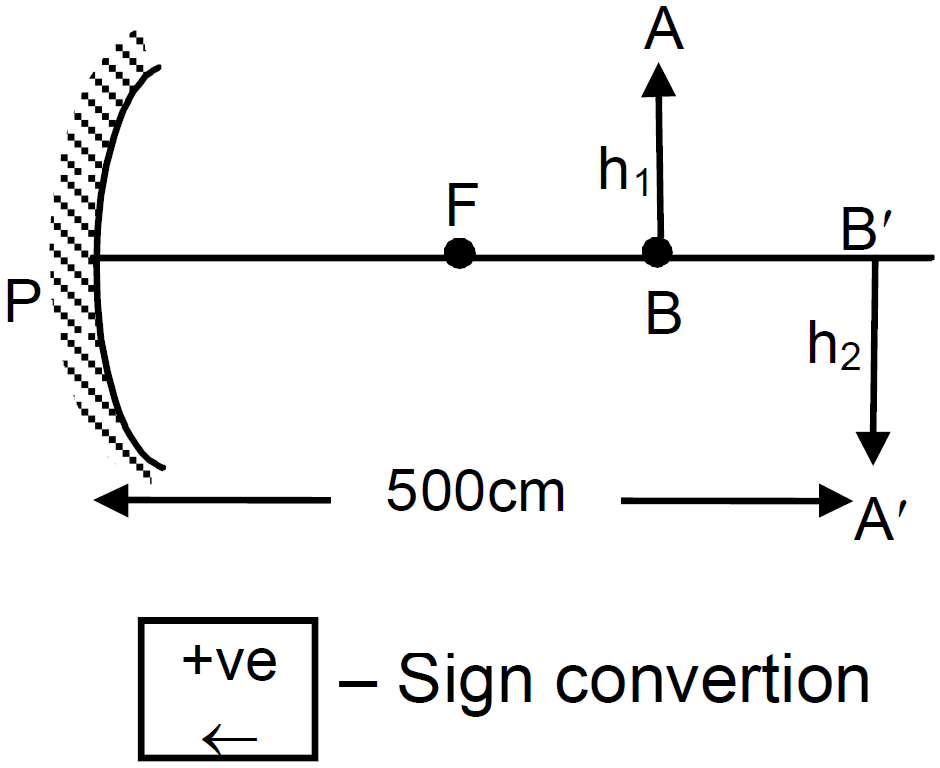
A concave mirror forms an image of 20cm high object on a screen placed 5.0m away from the mirror. The height of the image is 50cm. Find the focal length of the mirror and the distance between the mirror and the object.
Answer


Given that, $H_1 = 20cm, v = -5m = -500cm, h_2 = 50cm$
Since, $\frac{-\text{v}}{\text{u}}=\frac{\text{h}_2}{\text{h}_1}$ or
$\frac{500}{\text{u}}=-\frac{50}{20}$ (because the image in inverted) or
$\text{u}=-\frac{500\times2}{5}=-200\text{cm}=-2\text{m}$$\frac{1}{\text{v}}+\frac{1}{\text{u}}=\frac{1}{\text{f}}$ or $\frac{1}{-5}+\frac{1}{-2}=\frac{1}{\text{f}}$
or $\text{f}=\frac{-10}{7}=-1.44\text{m}$ So, the focal length is 1.44m.

Need a full question paper?

Generate a complete, print-ready paper with questions like this in minutes — across 16+ boards, with answer keys.
Start Generating Free

Similar questions

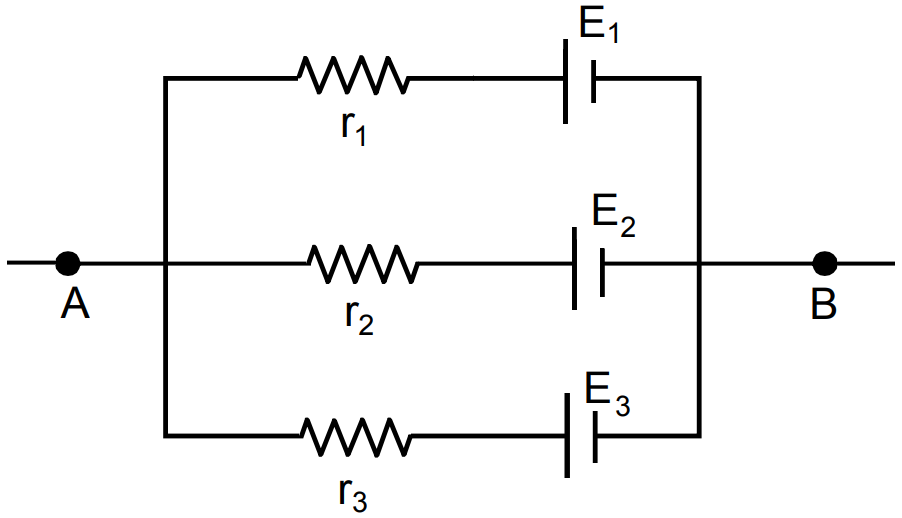
In the circuit shown in the figure. $\in_1=3\text{V},\in_2=2\text{V},\in_3=1\text{V}$ and $\text{r}_1=\text{r}_2=\text{r}_3=1\Omega.$ Find the potential difference between the points A and B and the current through each branch.
Repeat part (a) of problem 6 if the push is applied horizontally and not parallel to the incline.
An inductance of 2.0H, a capacitance of $18\mu\text{F}$ and a resistance of $10\text{K}\Omega$ are connected to an AC source of 20V with adjustable frequency.
  1. What frequency should be chosen to maximise the current in the circuit?
  2. What is the value of this maximum current?
A train running at 108km/h towards east whistles at a dominant frequency of 500Hz. Speed of sound in air is 340m/s.
  1. What frequency will a passenger sitting near the open window hear?
  2. What frequency will a person standing near the track hear whom the train has just passed?
  3. A wind starts blowing towards east at a speed f 36km/h. Calculate the frequencies heard by the passenger in the train and by the person standing near the track.
Gautam went for a vacation to the village where his grandmother lived. His grandmother took him to watch ‘nautanki’ one evening. They noticed a blackbox connected to the mike lying nearby. Gautam’s grandmother did not know what that box was. When she asked this question to Gautam, he explained to her that it was an amplifier.
  1. Which values were displayed by the grandmother? How can inculcation of these values in students be promoted?
  2. What is the function of an amplifier?
  3. Which basic electronic device is used in the amplifier?
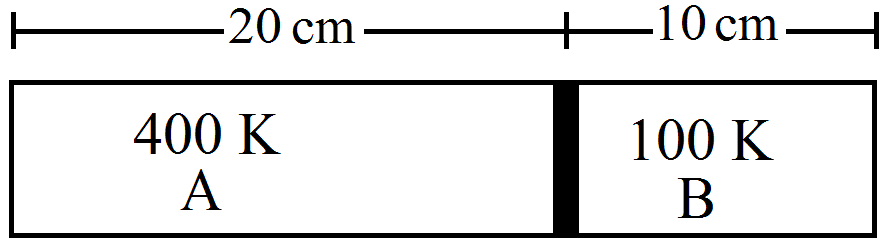
Figure. shows a cylindrical tube of length 30cm which is partitioned by a tight-fitting separator. The separator is very weakly conducting and can freely slide along the tube. Ideal gases are filled in the two parts of the vessel. In the beginning, the temperatures in the parts A and B are 400K and 100K respectively. The separator slides to a momentary equilibrium position shown in the figure. Find the final equilibrium position of the separator, reached after a long time.
An atom is in its excited state. Does the probability of its coming to ground state depend on whether the radiation is already present or not? If yes, does it also depend on the wavelength of the radiation present?
A parallel-plate capacitor having plate area $20cm^2$ and separation between the plates 1.00mm is connected to a battery of 12.0V. The plates are pulled apart to increase the separation to 2.0mm.
  1. Calculate the charge flown through the circuit during the process.
  2. How much energy is absorbed by the battery during the process?
  3. Calculate the stored energy in the electric field before and after the process.
  4. Using the expression for the force between the plates, find the work done by the person pulling the plates apart.
  5. Show and justify that no heat is produced during this transfer of charge as the separation is increased.
A magnetic field set up using Helmholtz coils (described in Exercise 4.16) is uniform in a small region and has a magnitude of 0.75 T. In the same region, a uniform electrostatic field is maintained in a direction normal to the common axis of the coils. A narrow beam of (single species) charged particles all accelerated through 15 kV enters this region in a direction perpendicular to both the axis of the coils and the electrostatic field. If the beam remains undeflected when the electrostatic field is $9.0 \times 10^{–5} V m^{–1}$, make a simple guess as to what the beam contains. Why is the answer not unique?
A sample of an ideal gas $(\gamma=1.5)$ is compressed adiabatically from a volume of $150cm^3$ to $50cm^3$. The initial pressure and the initial temperature are 150kPa and 300K. Find,
  1. The number of moles of the gas in the sample.
  2. The molar heat capacity at constant volume.
  3. The final pressure and temperature.
  4. The work done by the gas in the process.
  5. The change in internal energy of the gas.