Question
A magnetic field set up using Helmholtz coils (described in Exercise 4.16) is uniform in a small region and has a magnitude of 0.75 T. In the same region, a uniform electrostatic field is maintained in a direction normal to the common axis of the coils. A narrow beam of (single species) charged particles all accelerated through 15 kV enters this region in a direction perpendicular to both the axis of the coils and the electrostatic field. If the beam remains undeflected when the electrostatic field is $9.0 \times 10^{–5} V m^{–1}$, make a simple guess as to what the beam contains. Why is the answer not unique?
Answer

Magnetic field, $B = 0.75 T$
Accelerating voltage, $V = 15 kV = 15 \times 10^3 V$
Electrostatic field, $E = 9.0 \times 10^{-5} V m^{-1}$
Mass of the electron $= m$
Charge of the electron $= e$
Velocity of the electron $= v$
Kinetic energy of the electron $= eV$
$\Rightarrow\frac{1}{2}\text{mv}^{2}=\text{eV}$
$\therefore\frac{\text{e}}{\text{m}}=\frac{\text{v}^{2}}{2\text{V}}....(1)$
Since the particle remains undeflected by electric and magnetic fields, we can infer that the electric field is balancing the magnetic field.
$\therefore\text{eE}=\text{evB}$
$\text{v}=\frac{\text{E}}{\text{B}}...........(2)$
Putting equation (2) in equation (1), we get;
$\frac{\text{e}}{\text{m}}=\frac{1}{2}\frac{\Big(\frac{\text{E}}{\text{B}}\Big)^{2}}{\text{V}}=\frac{\text{E}^{2}}{2\text{VB}^{2}}$
$=\frac{(9.0\times10^{5})^{2}}{2\times15000\times(0.75)^{2}}$
$=4.8\times10^{7}\text{C/ kg}$
This value of specific charge e/m is equal to the value of deuteron or deuterium ions. This is not a unique answer. Other possible answers are $He^{++}, Li^{++},$ etc.

Need a full question paper?

Generate a complete, print-ready paper with questions like this in minutes — across 16+ boards, with answer keys.

Start Generating Free

Similar questions

The intensity of the sunlight reaching Earth is $1380Wm^{-2}$. Assume this light to be a plane, monochromatic wave. Find the amplitudes of electric and magnetic fields in this wave.
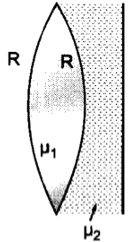
A biconvex lens with its two faces of equal radius of curvature $R$ is made of a transparent medium of refractive index $\mu_1$. It is kept in contact with a medium of refractive index $\mu_2$ as shown in the figure.
Image

$a.$ Find the equivalent focal length of the combination.
$b.$ Obtain the condition when this combination acts as a diverging lens.
$c.$ Draw the ray diagram for the case $\mu_1>\frac{\left(\mu_2+1\right)}{2}$, when the object is kept far away from the lens. Point out the nature of the image formed by the system.
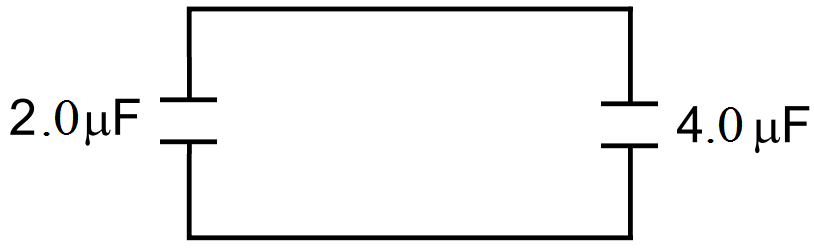
A capacitor of capacitance $2.0\mu\text{F}$ is charged to a potential difference of 12V. It is then connected to an uncharged capacitor of capacitance $4.0\mu\text{F}$ as shown in figure. Find:
  1. The charge on each of the two capacitors after the connection.
  2. The electrostatic energy stored in each of the two capacitors.
  3. The heat produced during the charge transfer from one capacitor to the other.
  1. Draw a labelled ray diagram showing the formation of image by a compound microscope in normal adjustment. Derive the expression for its magnifying power.
  2. How does the resolving power of a microscope change when.
  1. The diameter of the objective lens is decreased,
  2. The wavelength of the incident light is increased.
Justify your answer in each case.
A pin of length 2.00cm is placed perpendicular to the principal axis of a converging lens. An inverted image of size 1.00cm is formed at a distance of 40.0cm from the pin. Find the focal length of the lens and its distance from the pin.
The capacitance between the adjacent plates shown in figure is 50nF. A charge of $1.0\mu\text{C}$ is placed on the middle plate:
  1. What will be the charge on the outer surface of the upper plate?
  2. Find the potential difference developed between the upper and the middle plates.
A metal block of heat capacity $80J^\circ C^{-1} $ placed in a room at 20°C is heated electrically. The heater is switched off when the temperature reaches 30°C. The temperature of the block rises at the rate of $2^\circ Cs^{-1}$ just after the heater is switched on and falls at the rate of $0.2^\circ Cs^{-1}$ just after the heater is switched off. Assume Newton's law of cooling to hold.
  1. Find the power of the heater.
  2. Find the power radiated by the block just after the heater is switched off.
  3. Find the power radiated by the block when the temperature of the block is 25°C.
  4. Assuming that the power radiated at 25°C represents the average value in the heating process, find the time for which the heater was kept on.
A heater coil is to be constructed with a nichrome wire $(\rho=1.0\times10^{-6}\Omega-\text{m})$which can operate at 500W when connected to a 250V supply.
  1. What would be the resistance of the coil?
  2. If the cross-sectional area of the wire $0.5mm^2,$ what length of the wire will be needed?
  3. If the radius of each turn is 4.0mm, how many turns will be there in the coil?
Consider the following very rough model of a beryllium atom. The nucleus has four protons and four neutrons confined to a small volume of radius $10^{-15}m.$ The two 1s electrons make a spherical charge cloud at an average distance of $1.3 \times 10^{-11}m$ from the nucleus, whereas the two 2s electrons make another spherical cloud at an average distance of $5.2 \times 10^{-11}m$ from the nucleus. Find the electric field at:
  1. A point just inside the 1s cloud.
  2. A point just inside the 2s cloud.
A mercury lamp is a convenient source for studying frequency dependence of photoelectric emission, since it gives a number of spectral lines ranging from the UV to the red end of the visible spectrum. In our experiment with rubidium photo-cell, the following lines from a mercury source were used: $\lambda_1=3650\ \mathring{\text{A}},\ \lambda_2=4047\ \mathring{\text{A}},\ \lambda_3=4358\ \mathring{\text{A}},\ \lambda_4=5461\ \mathring{\text{A}},\ \lambda_5=6907\ \mathring{\text{A}},$ The stopping voltages, respectively, were measured to be: $V_{01} = 1.28 V, V_{02} = 0.95 V, V_{03} = 0.74 V, V_{04} = 0.16 V, V_{05} = 0 V$ Determine the value of Planck’s constant h, the threshold frequency and work function for the material. [Note: You will notice that to get h from the data, you will need to know e (which you can take to be $1.6 \times 10^{–19}$ C). Experiments of this kind on Na, Li, K, etc. were performed by Millikan, who, using his own value of e (from the oil-drop experiment) confirmed Einstein’s photoelectric equation and at the same time gave an independent estimate of the value of h.]