A condenser of $2\,\mu F$ capacitance is charged steadily from $0$ to $5\,C$. Which of the following graph represents correctly the variation of potential difference $(V)$ across it's plates with respect to the charge $(Q)$ on the condenser?
- A
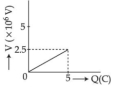
- B
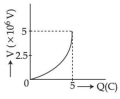
- C
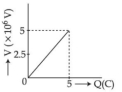
- D
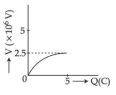
JEE MAIN 2022, Medium


Download our appand get started for free
Experience the future of education. Simply download our apps or reach out to us for more information. Let's shape the future of learning together!No signup needed.*
Similar Questions
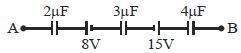
- 1The potential of the point $A$ is greater than that of $B$ by $19\, volt$. What is the potential difference in volts across the $3\,\mu F$ capacitor ?View Solution
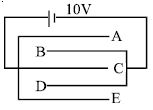
- 2Five identical capacitor plates are arranged such that they make capacitors each of $2\ \mu F$. The plates are connected to a source of $emf$ $10\ V$. The charge on plate $C$ is......$ \mu C$View Solution
- 3A cathode ray tube contains a pair of parallel metal plates $1.0\, cm$ apart and $3.0\, cm$ long. A narrow horizontal beam of electron with a velocity $3 \times 10^7\, m/s$ passed down the tube midway between the plates. When a potential difference of $550\, V$ is maintained across the plates, it is found that the electron beam is so deflected that it just strikes the end of one of the plates. Then the specific charge of the electron in $C/kg$ isView Solution
- 4Two capacitors of $1\,\mu F$ and $2\,\mu F$ are connected in series, the resultant capacitance will be.....$\mu \,F$View Solution
- 5Consider three concentric metallic spheres $A, B$ and $C$ of radii $a , b, c$, respectively where $a < b < c$. $A$ and $B$ are connected, whereas $C$ is grounded. The potential of the middle sphere $B$ is raised to $V$, then the charge on the sphere $C$ isView Solution
- 6An oil drop having charge $2e$ is kept stationary between two parallel horizontal plates $2.0\, cm$ apart when a potential difference of $12000\, volts$ is applied between them. If the density of oil is $900 \,kg/m^3$, the radius of the drop will beView Solution
- 7$S_1$ and $S_2$ are two equipotential surfaces on which the potentials are not equal. Which of the statement is incorrect ?View Solution
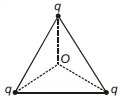
- 8Three isolated equal charges are placed at the three comers of an equilateral triangle as shown in figure. The statement which is true for net electric potential $V$ and net electric field intensity $E$ at the centre of the triangle isView Solution
- 9Two identical electric point dipoles have dipole moments $\overrightarrow{p}_{1}= p\hat i$ and $\overrightarrow{p}_{2}=- p\hat i$ and are held on the $x-$axis at distance $'a'$ from each other. When released, they move along the $x-$axis with the direction of their dipole moments remaining unchanged. If the mass of each dipole is $'m',$ their speed when they arc infinitely far apart isView Solution
- 10A conducting sphere $A$ of radius $a$, with charge $Q$, is placed concentrically inside a conducting shell $B$ of radius $b$. $B$ is earthed. $C$ is the common centre of the $A$ and $B$.View Solution
