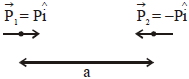
Two identical electric point dipoles have dipole moments $\overrightarrow{p}_{1}= p\hat i$ and $\overrightarrow{p}_{2}=- p\hat i$ and are held on the $x-$axis at distance $'a'$ from each other. When released, they move along the $x-$axis with the direction of their dipole moments remaining unchanged. If the mass of each dipole is $'m',$ their speed when they arc infinitely far apart is
JEE MAIN 2020, Medium


Download our appand get started for free
Experience the future of education. Simply download our apps or reach out to us for more information. Let's shape the future of learning together!No signup needed.*
Similar Questions
- 1View SolutionConsider a neutral conducting sphere. A positive point charge is placed outside the sphere. The net charge on the sphere is then,
- 2Two metallic charged spheres whose radii are $20\,cm$ and $10\,cm$ respectively, have each $150\,micro - coulomb$ positive charge. The common potential after they are connected by a conducting wire isView Solution
- 3For equal point charges $Q$ each are placed in the $xy$ plane at $(0, 2), (4, 2), (4, -2)$ and $(0, -2)$. The work required to put a fifth change $Q$ at the origin of the coordinate system will beView Solution
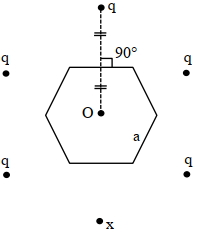
- 4Six charges are placed around a regular hexagon of side length a as shown in the figure. Five of them have charge $q$, and the remaining one has charge $x$. The perpendicular from each charge to the nearest hexagon side passes through the center $O$ of the hexagon and is bisected by the side.View Solution
Which of the following statement($s$) is(are) correct in SI units?
$(A)$ When $x=q$, the magnitude of the electric field at $O$ is zero.
$(B)$ When $x=-q$, the magnitude of the electric field at $O$ is $\frac{q}{6 \pi \in_0 a^2}$.
$(C)$ When $x=2 q$, the potential at $O$ is $\frac{7 q}{4 \sqrt{3} \pi \in_0 a}$.
$(D)$ When $x=-3 q$, the potential at $O$ is $\frac{3 q}{4 \sqrt{3} \pi \in_0 a}$.
- 5Two positively charged particles $X$ and $Y$ are initially far away from each other and at rest. $X$ begins to move towards $Y$ with some initial velocity. The total momentum and energy of the system are $p$ and $E$.View Solution
- 6A series combination of $n_1$ capacitors, each of value $C_1$ is charged by a source of potential difference $4\, V.$ When another parallel combination of $n_2$ capacitors, each of value $C_2,$ is charged by a source of potential difference $V$, it has the same (total) energy stored in it, as the first combination has. The value of $C_2,$ in terms of $C_1$ is thenView Solution
- 7An electron of mass $m$ and charge $e$ is accelerated from rest through a potential difference $V$ in vacuum. Its final velocity will beView Solution
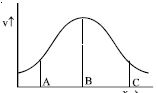
- 8Variation of electrostatic potential along $x$-direction is shown in the graph. The correct statement about electric field isView Solution
- 9The material filled between the plates of a parallel plate capacitor has resistivity $200 \Omega \, {m}$. The value of capacitance of the capacitor is $2\, {pF}$. If a potential difference of $40 \,{V}$ is applied across the plates of the capacitor, then the value of leakage current flowing out of the capacitor isView Solution
(given the value of relative permitivity of material is $50$ )
- 10$64$ identical drops each charged upto potential of $10\,mV$ are combined to form a bigger dorp. The potential of the bigger drop will be $..........\,mV$View Solution