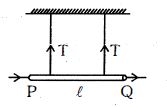
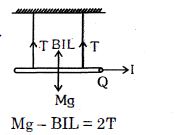
A conducting bar $PQ$ of length $l$ carrying current $I$ is suspended from a rigid support as shown in figure. A uniform magnetic field $B$ perpendicular to $PQ$ and directed away from the reader (inside the plane) is applied. If the mass of the bar is $M$ the tension in each string is
Medium


Download our appand get started for free
Experience the future of education. Simply download our apps or reach out to us for more information. Let's shape the future of learning together!No signup needed.*
Similar Questions
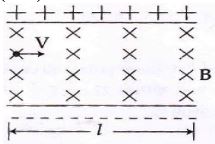
- 1An electron moves straight inside a charged parallel plate capacitor of uniform charge density. The space between the plates is filled with uniform magnetic field of intensity $B ,$ as shown in the figure, Neglecting effect of gravity, the time of straight line motion of the electron in the capacitor isView Solution
- 2View SolutionConsider the following statements regarding a charged particle in a magnetic field . Which of the statements are true :
- 3The force exerted by a magnetic field on a wire having length $L$ and current $I$ is perpendicular to the wire and given as $\left| F \right| = IL\left| B \right|$ . An experimental plot shows $(\vec F)$ as function of $L$ . The plot is a straight line with a slope $S = \left( {10 \pm 1} \right) \times {10^{ - 5}}\ AT$. The current in the wire is $\left( {15 \pm 1} \right)\ mA$ . The percentage error in $B$ isView Solution
- 4View SolutionAn electron moves along vertical line and away from the observer, then pattern of concentric circular magnetic field lines which are produced due to its motion
- 5The maximum current that can be measured by a galvanometer of resistance $40 \,\Omega$ is $10\, mA$. It is converted into a voltmeter that can read upto $50\, V$. The resistance to be connected in series with the galvanometer is ... (in $ohm$)View Solution
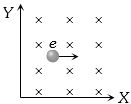
- 6View SolutionIn the given figure, the electron enters into the magnetic field. It deflects in ...... direction
- 7In the productView Solution
$\overrightarrow{\mathrm{F}} =\mathrm{q}(\vec{v} \times \overrightarrow{\mathrm{B}})$
$=\mathrm{q} \vec{v} \times\left(\mathrm{B} \hat{i}+\mathrm{B} \hat{j}+\mathrm{B}_{0} \hat{k}\right)$
For $\mathrm{q}=1$ and $\vec{v}=2 \hat{i}+4 \hat{j}+6 \hat{k}$ and
$\overrightarrow{\mathrm{F}}=4 \hat{i}-20 \hat{j}+12 \hat{k}$
What will be the complete expression for $\vec{B}$ ?
- 8The radius of a circular loop is $r$ and a current $i$ is flowing in it. The equivalent magnetic moment will beView Solution
- 9View SolutionIf a positive ion is moving, away from an observer with same acceleration, then the lines of force of magnetic induction will be
- 10Consider the motion of a positive point charge in a region where there are simultaneous uniform electric and magnetic fields $\vec{E}=E_0 \hat{j}$ and $\vec{B}=B_0 \hat{j}$. At time $t=0$, this charge has velocity $\nabla$ in the $x$-y plane, making an angle $\theta$ with $x$-axis. Which of the following option$(s)$ is(are) correct for time $t>0$ ?View Solution
$(A)$ If $\theta=0^{\circ}$, the charge moves in a circular path in the $x-z$ plane.
$(B)$ If $\theta=0^{\circ}$, the charge undergoes helical motion with constant pitch along the $y$-axis.
$(C)$ If $\theta=10^{\circ}$, the charge undergoes helical motion with its pitch increasing with time, along the $y$-axis.
$(D)$ If $\theta=90^{\circ}$, the charge undergoes linear but accelerated motion along the $y$-axis.