In the given figure, the electron enters into the magnetic field. It deflects in ...... direction
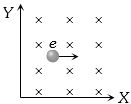
Easy


Download our appand get started for free
Experience the future of education. Simply download our apps or reach out to us for more information. Let's shape the future of learning together!No signup needed.*
Similar Questions
- 1View SolutionTo make the field radial in a moving coil galvanometer
- 2A charge moving with velocity $v$ in $X$-direction is subjected to a field of magnetic induction in the negative $X$-direction. As a result, the charge willView Solution
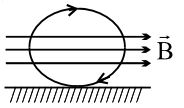
- 3A conducting ring of mass $2\,\, kg$ and radius $0.5\,\ m$ is placed on a smooth horizontal plane. The ring carries a current $i = 4A. A$ horizontal magnetic field $B = 10T$ is switched on at time $t = 0$ as shown in figure. The initial angular acceleration of the ring will beView Solution
- 4A proton moving with a velocity, $2.5 \times {10^7}\,m/s$, enters a magnetic field of intensity $2.5\,T$ making an angle ${30^o}$ with the magnetic field. The force on the proton isView Solution
- 5A square loop of side $2a$ and carrying current I is kept in $xz$ plane with its centre at origin. A long wire carrying the same current I is placed parallel to $z-$axis and passing through point $(0, b , 0),( b >> a ) .$ The magnitude of torque on the loop about $z-$ax is will beView Solution
- 6A circular loop has a radius of $5\, cm$ and it is carrying a current of $0.1\, amp$. Its magnetic moment isView Solution
- 7A proton moving with a velocity, $2.5 \times {10^7}\,m/s$, enters a magnetic field of intensity $2.5\,T$ making an angle ${30^o}$ with the magnetic field. The force on the proton isView Solution
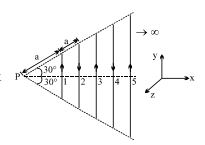
- 8Infinite number of straight wires each carrying current $I$ are equally placed as shown in the figure. Adjacent wires have current in opposite direction. Net magnetic field at point $P$ isView Solution
- 9The magnetic field at the centre of a circular current carrying-conductor of radius $r$ is $B_c$. The magnetic field on its axis at a distance $r$ from the centre is $B_a$. The value of $B_c$ : $B_a$ will beView Solution
- 10A charged particle carrying charge $1\,\mu C$ is moving with velocity $(2 \hat{ i }+3 \hat{ j }+4 \hat{ k })\, ms ^{-1} .$ If an external magnetic field of $(5 \hat{ i }+3 \hat{ j }-6 \hat{ k }) \times 10^{-3}\, T$ exists in the region where the particle is moving then the force on the particle is $\overline{ F } \times 10^{-9} N$. The vector $\overrightarrow{ F }$ is :View Solution