MCQ
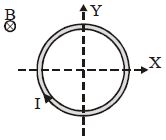
A conducting loop carrying a current $I$ is placed in a uniform magnetic field pointing into the plane of the paper as shown. The loop will have a tendency to
  • A
    Contract
  • Expand
  • C
    Move towards $+ve\, x-$ axis
  • D
    Move towards $-ve\, x-$ axis

Answer

Correct option: B.
Expand
b
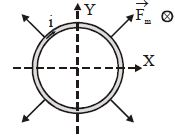
Net force on a current carrying loop in uniform magnetic field is zero. Hence the loop can't translate. So, options $(C)$ and $(D)$ are wrong From Fleming's left hand rule we can see that if magnetic field is perpendicular to paper inwards and current in the loop is clockwise (as shown) the magnetic force $\vec F_m$ on each element of the loop is radially outwards, or the loops will have a tendency to expand

Need a full question paper?

Generate a complete, print-ready paper with questions like this in minutes — across 16+ boards, with answer keys.
Start Generating Free

Similar questions

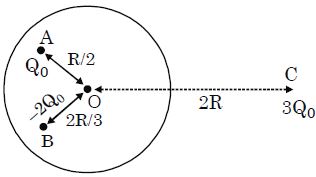
A thin conducting spherical shell (center at $O$ ) having charge $Q_0$ , radius $R$ and three point charges $Q_0$ , $-2Q_0$ , $3Q_0$ are also kept at point $A$ , $B$ and $C$ respectively as shown. Find the potential at any point on the conducting shell. (Potential at infinity is assumed to be zero)
Correct relation for triode is
Given below are two statements:

Statement$-I :$ An elevator can go up or down with uniform speed when its weight is balanced with the tension of its cable.

Statement$-II :$ Force exerted by the floor of an elevator on the foot of a person standing on it is more than his/her weight when the elevator goes down with increasing speed.

In the light of the above statements, choose the correct answer from the options given below :

The compound $A$ in the following reaction is :

$A\xrightarrow[{(ii)\,\,Conc.\,{H_2}S{O_4}/\Delta }]{{{\text{(i)}}\,{\text{C}}{{\text{H}}_3}MgBr/{H_2}O}}$

$B\xrightarrow[{(ii)\,Zn/{H_2}O}]{{(i)\,{O_3}}}C + D$

$D\xrightarrow[\Delta ]{{Ba\left( {OH} \right)}}\begin{array}{*{20}{c}} {\,\,\,\,\,\,\,\,\,\,\,\,\,\,\,\,\,\,\,\,\,\,\,\,C{H_3}} \\ {\,\,\,\,\,\,\,\,\,\,\,\,\,\,\,\,|} \\ {{H_3}C - C} \end{array}$$\begin{array}{*{20}{c}} {\,\,\,\,\,\,\,O} \\ {\,\,\,\,\,||} \\ { = CH - C - C{H_3}} \end{array}$

In series $RLC$ circuit $(AC)$

$L = 10\, mH$

$C = 0.01\,\mu F$

$R = 50\,\Omega $

If supply voltage is $V = 10\sin \omega t$ then find power dissipated at resonance......$W$
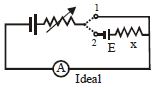
In the circuit shown the variable resistance is so adjusted that the ammeter reading is same in both the position $1$ and $2$ of the key. The reading of ammeter is $2A$. If $E = 20V$, then $x$ is :- ................... $\Omega$
Two satellite are revolving around the earth with velocities ${v_1}$and ${v_2}$ and in radii ${r_1}$ and ${r_2}({r_1} > {r_2})$respectively. Then
A cubical block of wood of specific gravity $0.5$ and a chunk of concrete of specific gravity $2.5$ are fastened together. The ratio of the mass of wood to the mass of concrete which makes the combination to float with its entire volume submerged under water is
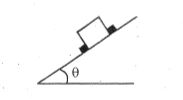
A railway line is taken round a circular arc of radius $1000\ m$ , and is banked by raising the outer rail $h$ $m$ above the inner rail. If the lateral force on the inner rail when a train travels round the curve at $10\ ms^{-1}$ is equal to the lateral force on the outer rail when the train's speed is $20\ ms^{-1}$ . The value of $4g\ tan\theta $ is equal to : (The distance between the rails is $1.5\ m$ )
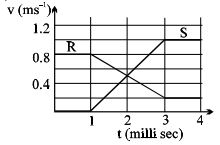
The diagram to the right shows the velocity-time graph for two masses $R$ and $S$ that collided elastically. Which of the following statements is true?

$(I)$ $R$ and $S$ moved in the same direction after the collision.

$(II)$ Kinetic energy of the system $(R$ & $S)$ is minimum at $t = 2$ milli sec.

$(III)$ The mass of $R$ was greater than mass of $S.$