MCQ
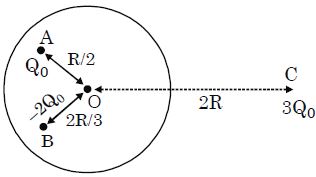
A thin conducting spherical shell (center at $O$ ) having charge $Q_0$ , radius $R$ and three point charges $Q_0$ , $-2Q_0$ , $3Q_0$ are also kept at point $A$ , $B$ and $C$ respectively as shown. Find the potential at any point on the conducting shell. (Potential at infinity is assumed to be zero)
  • A
    $\frac{{5K{Q_0}}}{{2R}}$
  • $\frac{3}{2}\frac{{K{Q_0}}}{R}$
  • C
    $\frac{{K{Q_0}}}{{3R}}$
  • D
    None of these

Answer

Correct option: B.
$\frac{3}{2}\frac{{K{Q_0}}}{R}$
b
Charge on outer surface of shell is

$Q_{0}+Q_{0}-2 Q_{0}=0$

So potential at surface $=\frac{\mathrm{K} 3 \mathrm{Q}_{0}}{2 \mathrm{R}}$

Need a full question paper?

Generate a complete, print-ready paper with questions like this in minutes — across 16+ boards, with answer keys.

Start Generating Free

Similar questions

Two identical thin plano-convex glass lenses (refractive index $1.5$) each having radius of curvature of $20\,\, cm$ are placed with their convex surfaces in contact at the centre. The intervening space is filled with oil of refractive index $1. 7$ .  The focal length of the combination is.......$cm$
If $\varepsilon_0, \mu_0$ and c represent the relative permittivity of free space, the magnetic permeability of free space, and the velocity of light respectively, which of the following combinations is correct?
At what temperature is the root mean square velocity of gaseous hydrogen molecules is equal to that of oxygen molecules at $47°C$ ..... $K$
In a Wheatstone’s bridge all the four arms have equal resistance $R$. If the resistance of the galvanometer arm is also $R$, the equivalent resistance of the combination as seen by the battery is
A capacitor is charged by using a battery which is then disconnected. A dielectric slab is then slipped between the plates, which results in
A particle moves with simple harmonic motion in a straight line. In first $\tau \,s,$ after starting from rest it travels a distance $a,$ and in next $\tau \,s$ it travels $2a,$ in same direction, then
A soldier with a machine gun, falling from an alrplane gets detached from his parachute. He is able to resist the downward acceleration, if he shoots $40$ bullets a second at the speed of $500 \,m / s$. If the weight of a bullet is $49 \,g$, the weight of the man .......... $ \,kg$ with the gun? Ignore resistance due to air and assume the acceleration due to gravity, $g=9.8 \,ms ^{-2}$.
Potential difference between centre $\&$ the surface of sphere of radius $R$ and uniform volume charge density $\rho$ within it will be :
Light energy emitted by stars is due to
A plano-convex lens (focal length $f_2,$ refractive index $\mu _2,$ radius of curvature $R$ ) fits exactly into a plano-concave lens (focal length $f_1,$ refractive index $\mu _1,$ radius of curvature $R$ ). Their plane surfaces are parallel to each other. Then, the focal length of the combination will be