MCQ
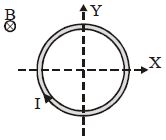
A conducting loop carrying a current $I$ is placed in a uniform magnetic field pointing into the plane of the paper as shown. The loop will have a tendency to
  • A
    Contract
  • Expand
  • C
    Move towards $+ve\, x-$ axis
  • D
    Move towards $-ve\, x-$ axis

Answer

Correct option: B.
Expand
b
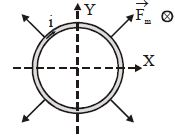
Net force on a current carrying loop in uniform magnetic field is zero. Hence the loop can't translate. So, options $(C)$ and $(D)$ are wrong From Fleming's left hand rule we can see that if magnetic field is perpendicular to paper inwards and current in the loop is clockwise (as shown) the magnetic force $\vec F_m$ on each element of the loop is radially outwards, or the loops will have a tendency to expand

Need a full question paper?

Generate a complete, print-ready paper with questions like this in minutes — across 16+ boards, with answer keys.
Start Generating Free

Similar questions

The electric potential at a point on the equatorial line of an electric dipole is:
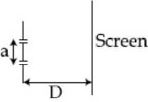
The figure shows a Young’s double slit experimental setup. It is observed that when a thin transparent sheet of thickness $t$ and refractive index $\mu $ is put in front of one of the slits, the central maximum gets shifted by a distance equal to $n$ fringe widths. If the wavelength of light used is $\lambda ,\,t$ will be
Heavy water is
In a certain double slit experimental arrangement interference fringes of width $ 1.0 mm$  each are observed when light of wavelength $ 5000 Å $ is used. Keeping the set up unaltered, if the source is replaced by another source of wavelength $6000 Å, $ the fringe width will be......$mm$
An object of height 1.5 cm is placed on the axis of a convex lens of focal length 25 cm. A real image is formed at a distance of 75 cm from the lens. The size of the image will be
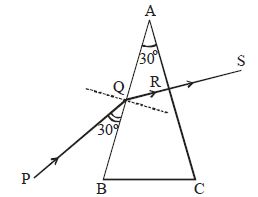
In the diagram, a prism of angle $30^o$ is used. A ray $PQ$ is incident as shown. An emergent ray $RS$ emerges perpendicular to the second face. The angle of deviation is.....$^o$
We wish to make a microscope with the help of two positive lenses both with a focal length of $20\, mm$ each and the object is positioned $25\, mm$ from the objective lens. How far apart the lenses should be so that the final image is formed at infinity?......$mm$
A pulse of light of duration $100 \ ns$ is absorbed completely by a small object initially at rest. Power of the pulse is $30 \ mV$ and the speed of light is $3 \times 10 ^8\ ms ^{-1}$. The final momentum of the object is :
Which of these is unipolar transistor
Identify the simplest and the most widely used capacitor among the following.