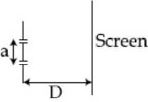
- A$\frac{{2nD\lambda }}{{a\left( {\mu - 1} \right)}}$
- B$\frac{{nD\lambda }}{{a\left( {\mu - 1} \right)}}$
- C$\frac{{2D\lambda }}{{a\left( {\mu - 1} \right)}}$
- ✓$\frac{{n\lambda }}{{\left( {\mu - 1} \right)}}$
$(\mu-1) \,t \frac{D}{d}=n \frac{\lambda D}{d},$ according to eh question $t=\frac{n \lambda}{(\mu-1)}$
No option is matching, therefore question should be award bonus.
$\therefore $ Correct option should be (Bonus)
Generate a complete, print-ready paper with questions like this in minutes — across 16+ boards, with answer keys.


$E=\frac{3}{5} \frac{Z(Z-1) e^2}{4 \pi \varepsilon_0 R}$
The measured masses of the neutron, ${ }_1^1 \mathrm{H},{ }_7^{15} \mathrm{~N}$ and ${ }_8^{15} \mathrm{O}$ are $1.008665 \mathrm{u}, 1.007825 \mathrm{u}$, $15.000109 \mathrm{u}$ and $15.003065 \mathrm{u}$, respectively. Given that the radii of both the ${ }_7^{15} \mathrm{~N}$ and ${ }_8^{15} \mathrm{O}$ nuclei are same, $1 \mathrm{u}=931.5 \mathrm{MeV} / \mathrm{c}^2$ ( $c$ is the speed of light) and $e^2 /\left(4 \pi \varepsilon_0\right)=1.44 \mathrm{MeV} \mathrm{fm}$. Assuming that the difference between the binding energies of ${ }_7^{15} \mathrm{~N}$ and ${ }_8^{15} \mathrm{O}$ is purely due to the electrostatic energy, the radius of either of the nuclei is
$\left(1 \mathrm{fm}=10^{-15} \mathrm{~m}\right.$ )