A conducting sphere of radius $10\, cm$ is charged $10\,\mu \,C$. Another uncharged sphere of radius $20\, cm$ is allowed to touch it for some time. After that if the sphere are separated, then surface density of charges, on the spheres will be in the ratio of
AIIMS 2002, Medium


Download our appand get started for free
Experience the future of education. Simply download our apps or reach out to us for more information. Let's shape the future of learning together!No signup needed.*
Similar Questions
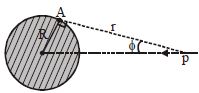
- 1A dipole having dipole moment $p$ is placed in front of a solid uncharged conducting sphere as shown in the diagram. The net potential at point $A$ lying on the surface of the sphere is :-View Solution
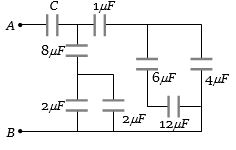
- 2In the following circuit, the resultant capacitance between $A$ and $B$ is $1\,\mu F$. Then value of $C$ isView Solution
- 3Three concentric spherical shells have radii $a, b$ and $c (a < b < c)$ and have surface charge densities $\sigma ,-\;\sigma $ and $\;\sigma \;$ respectively. If $V_A,V_B$ and $V_C$ denote the potentials of the three shells, then, for $c = a +b,$ we haveView Solution
- 4A $500 \,\mu F$ capacitor is charged at a steady rate of $100\, \mu C/sec$. The potential difference across the capacitor will be $10\, V$ after an interval of.....$sec$View Solution
- 5View SolutionThe ratio of charge to potential of a body is known as
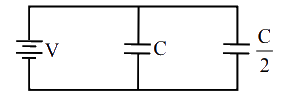
- 6Two condensers, one of capacity $C$ and other of capacity $C/2$ are connected to a $V-$ volt battery, as shown in the figure. The work done in charging fully both the condensers isView Solution
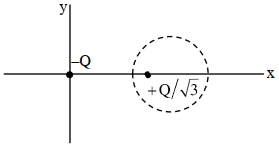
- 7Two point charges $-Q$ and $+Q / \sqrt{3}$ are placed in the xy-plane at the origin $(0,0)$ and a point $(2,0)$, respectively, as shown in the figure. This results in an equipotential circle of radius $R$ and potential $V =0$ in the $xy$-plane with its center at $(b, 0)$. All lengths are measured in meters.View Solution
($1$) The value of $R$ is. . . . meter.
($2$) The value of $b$ is. . . . . .meter.
- 8A capacitor is connected to a $20\, {V}$ battery through a resistance of $10\, \Omega .$ It is found that the potential difference across the capacitor rises to $2\, {V}$ in $1\, \mu {s}$. The capacitance of the capacitor is $....\,\mu {F}$ Given : $\ln \left(\frac{10}{9}\right)=0.105$View Solution
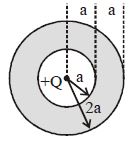
- 9A solid spherical conducting shell has inner radius a and outer radius $2a$. At the center of the shell is located a point charge $+Q$. What must the excess charge of the shell be in order for the charge density on the inner and outer surfaces of the shell to be exactly equal ?View Solution
- 10An arc of radius $r$ carries charge. The linear density of charge is $\lambda$ and the arc subtends a angle $\frac{\pi }{3}$ at the centre. What is electric potential at the centreView Solution