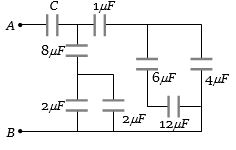
In the following circuit, the resultant capacitance between $A$ and $B$ is $1\,\mu F$. Then value of $C$ is
Diffcult


Download our appand get started for free
Experience the future of education. Simply download our apps or reach out to us for more information. Let's shape the future of learning together!No signup needed.*
Similar Questions
- 1A parallel plate capacitor has plate of length $'l',$ width $'w'$ and separation of plates is $'d'.$ It is connected to a battery of emf $V$. A dielectric slab of the same thickness '$d$' and of dielectric constant $k =4$ is being inserted between the plates of the capacitor. At what length of the slab inside plates, will be energy stored in the capacitor be two times the initial energy stored$?$View Solution
- 2A point charge of magnitude $+ 1\,\mu C$ is fixed at $(0, 0, 0) $. An isolated uncharged spherical conductor, is fixed with its center at $(4, 0, 0).$ The potential and the induced electric field at the centre of the sphere isView Solution
- 3The dielectric constant $k$ of an insulator cannot beView Solution
- 4A capacitor of capacity $'C'$ is connected to a cell of $'V'\, volt$. Now a dielectric slab of dielectric constant ${ \in _r}$ is inserted in it keeping cell connected thenView Solution
- 5A parallel plate capacitor of capacitance $2\; F$ is charged to a potential $V$. The energy stored in the capacitor is $E_1$. The capacitor is now connected to another uncharged identical capacitor in parallel combination. The energy stored in the combination is $E _2$. The ratio $E _2 / E _1$ isView Solution
- 6A particle of mass $m$ and charge $q$ is kept at the top of a fixed frictionless sphere. $A$ uniform horizontal electric field $E$ is switched on. The particle looses contact with the sphere, when the line joining the center of the sphere and the particle makes an angle $45^o$ with the vertical. The ratio $\frac{qE}{mg}$ is :-View Solution
- 7Positive and negative point charges of equal magnitude are kept at $\left(0,0, \frac{a}{2}\right)$ and $\left(0,0, \frac{-a}{2}\right)$, respectively. The work done by the electric field when another positive point charge is moved from $(-a, 0,0)$ to $(0, a, 0)$ isView Solution
- 8Two capacitors of capacitances $1\ \mu F$ and $3\ \mu F$ are charged to the same voltages $5\,V$. They are connected in parallel with oppositely charged plates connected together. Then:View Solution
- 9Three capacitors each of capacitance $C$ and of breakdown voltage $V$ are joined in series. The capacitance and breakdown voltage of the combination will beView Solution
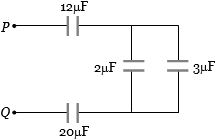
- 10In the circuit diagram shown in the adjoining figure, the resultant capacitance between $P$ and $Q$ is........$\mu F$View Solution