The ratio of charge to potential of a body is known as
Easy
Download our app for free and get started
(a) The capacitance of a capacitor to store electric charge is given
by
$C=\frac{Q}{V}$
(where $Q$ is the charge of the capacitor and $V$ is voltage)
Therefore, the ratio of charge to potential is capacitance.

Download our appand get started for free
Experience the future of education. Simply download our apps or reach out to us for more information. Let's shape the future of learning together!No signup needed.*
Similar Questions
- 1If the capacity of a spherical conductor is $1$ picofarad, then its diameter, would beView Solution
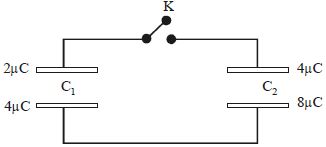
- 2Assertion : Charges are given to plates of two plane parallel plate capacitors $C_1$ and $C_2$ (such that $C_2 = 2C_1$ ) as shown in figure. Then the key $K$ is pressed to complete the circuit. Finally the net charge on upper plate and net charge the circuit. Finally the net charge on upper plate and net charge on lower plate of capacitor $C_1$ is positive.View Solution
Reason : In a parallel plate capacitor both plates always carry equal and opposite charge.
- 3The plates of a parallel plate capacitor are charged up to $100\, volt$. A $2\, mm$ thick plate is inserted between the plates, then to maintain the same potential difference, the distance between the capacitor plates is increased by $1.6\, mm$. The dielectric constant of the plate isView Solution
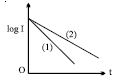
- 4A capacitor of capacity $C$ is charged to a steady potential difference $V$ and connected in series with an open key and a pure resistor $'R'$. At time $t = 0$, the key is closed. If $I =$ current at time $t$, a plot of log $I$ against $'t'$ is as shown in $(1)$ in the graph. Later one of the parameters i.e. $V, R$ or $C$ is changed keeping the other two constant, and the graph $(2)$ is recorded. ThenView Solution
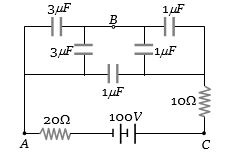
- 5In the figure below, what is the potential difference between the point $A$ and $B$ and between $B$ and $C$ respectively in steady stateView Solution
- 6A capacitor is connected to a $10\,V$ battery. The charge on the plates is $10\,\mu C$ when medium between plates is air. The charge on the plates become $100\,\mu C$ when space between plates is filled with oil. The dielectric constant of oil isView Solution
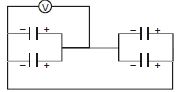
- 7The four capacitors, each of $25\,\mu \,F$ are connected as shown in fig. The $dc$ voltmeter reads $200\,V$. The charge on each plate of capacitor isView Solution
- 8The electrostatic potential inside a charged spherical ball is given by : $V = b -ar^2$, where $r$ is the distance from the centre ; $a$ and $b$ are constants. Then, the charge density inside the ball is :View Solution
- 9View SolutionPolar molecules are the molecules:
- 10A $12\,pF$ capacitor is connected to a $50\,V$ battery. How much electrostatic energy is stored in the capacitorView Solution