MCQ
A conductor carries a certain charge. When it is connected to another uncharged conductor of finite capacity, then the energy of the combined system is.
  • A
    More than that of the first conductor.
  • B
    Less than that of the first conductor.
  • C
    Equal to that of the first conductor.
  • D
    Uncertain.

Answer

  1. Less than that of the first conductor.

Need a full question paper?

Generate a complete, print-ready paper with questions like this in minutes — across 16+ boards, with answer keys.

Start Generating Free

Similar questions

The equivalent resistance of resistors connected in series is always

(a) Equal to the mean of component resistors

(b) Less than the lowest of component resistors

(c) In between the lowest and the highest of component resistors

(d) Equal to sum of component resistors

The resistance of a wire is R. If the length of the wire is doubled by stretching, then the new resistance will be

(a) 2R

(b) 4R

(c) R 

(d)  

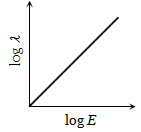
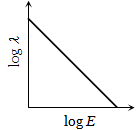
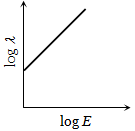
The log-log graph between the energy E of an electron and its de-Broglie wavelength λ  will be

(a)

(a)

(c)

(d)

A solid sphere, a hollow sphere and a disc, all having same mass and radius, are placed at the top of an incline and released. The friction coefficients between the objects and the incline are same and not sufficient to allow pure rolling. Least time will be taken in reaching the bottom by:
  1. The solid sphere.
  2. The hollow sphere.
  3. The disc.
  4. All will take same time.
Coulomb’s law is true for:
In an insulator, the forbidden energy gap between the valence band and conduction band is of the order of:
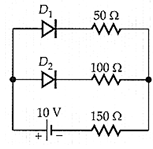
Assume that each diode shown in the figure has a forward bias resistance of $50 \Omega$ and an infinite reverse bia resistance. The current through the $150 \Omega$ resistance is
Image
The energy density in the electric field created by a point charge falls off with the distance from the point charge as:

An electric dipole is placed along the x - axis at the origin  O. A point P is at a distance of 20 cm from this origin such that OP makes an angle   with the x-axis. If the electric field at  P makes an angle θ with the x-axis, the value of θ  would be

(a)  

(b)

(c)

(d)

A wire loop is rotated in a magnetic field. The frequency of change of direction of the induced e.m.f. is.