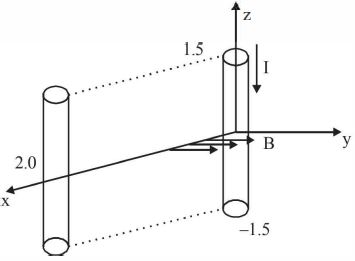
A conductor lies along the $z-$axis $a$ $-1.5$$ \le Z < 1.5\,m$ carries a fixed current of $10.0\ A$ in $ - {\hat a_z}$ direction (see figure). For a field $\vec B$ $=$ $3.0 \times 10^{-4}$ $e^{-0.2x}$ ${\hat a_y}\,T$ find the power required to move the conductor at constant speed to $x = 2.0\ m, y = 0\ m$ in $5 \times 10^{-3}\ s$. Assume parallel motion along the $x-$axis........$ W$
JEE MAIN 2014, Diffcult


Download our appand get started for free
Experience the future of education. Simply download our apps or reach out to us for more information. Let's shape the future of learning together!No signup needed.*
Similar Questions
- 1A circular coil is in $y-z$ plane with centre at the origin. The coil is carrying a constant current. Assuming direction of magnetic field at $x = -25\, cm$ to be positive direction of magnetic field, which of the following graphs shows variation of magnetic field along $x-$ axisView Solution
- 2View SolutionA stream of electrons is projected horizontally to the right. A straight conductor carrying a current is supported parallel to electron stream and above it. If the current in the conductor is from left to right then what will be the effect on electron stream
- 3Two long parallel wires are at a distance $2d$ apart. They carry steady equal currents flowing out of the plane of the paper, as shown. The variation of the magnetic field $B$ along the line $XX’$ is given byView Solution
- 4A particle of specific charge $(q/m)$ is projected from the origin of coordinates with initial velocity $[ui - vj]$. Uniform electric magnetic fields exist in the region along the $+y$ direction, of magnitude $E$ and $B.$ The particle will definitely return to the origin once ifView Solution
- 5A particle of mass $m$ and charge $q$ moves with a constant velocity $v$ along the positive $x$ direction. It enters a region containing a uniform magnetic field $B$ directed along the negative $z$ direction, extending from $x = a$ to $x = b$. The minimum value of $v$ required so that the particle can just enter the region $x > b$ isView Solution
- 6When a galvanometer is shunted with a $4\,\Omega$ resistance, the deflection is reduced to one-fifth. If the galvanometer is further shunted with $2\,\Omega$ wire, the further reduction in the deflection will be (the main current remains same)View Solution
- 7Two circular coils $1$ and $2$ are made from the same wire but the radius of the $1^{st}$ coil is twice that of the $2^{nd}$ coil. What is the ratio of potential difference in volts should be applied across them so that the magnetic field at their centres is the same?View Solution
- 8View SolutionTesla is the unit of
- 9The maximum velocity to which a proton can be accelerated in a cyclotron of $10\, MHz$ frequency and radius $50\, cm$ isView Solution
- 10View SolutionIf an electron enters a magnetic field with its velocity pointing in the same direction as the magnetic field, then