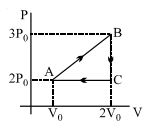
A constant amount of an ideal gas undergoes the cyclic process $A B C A$ in the $p-V$ graph shown below. The path $B C$ is an isothermal. The work done by the gas during one complete cycle, beginning and ending at $A$ is nearly .......... $\,kJ$
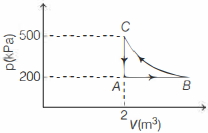
KVPY 2011, Diffcult
Download our app for free and get started
(c)
$\ln$ isothermal process $B C$,
$p V=\text { constant }$
$\Rightarrow \quad D_C V_C=p_B V_B$
$\Rightarrow \quad \frac{p_C V_C-500 \times 2}{p_B}=5\, m ^3$
Now, work done in the complete cycle $C A B C$ is
$W_{C A B C}=W_{C A}+W_{A B}+W_{B C}$
$=0+p \Delta V+\int p d V$
$=200(5-2)+\int \limits_5^2 k \frac{d V}{V}$
$=600+k \int \limits_5^2 \frac{d V}{V}$
$=600+1000(\log 2-\log 5)$
$=600+1000(0.69-160)$
$=600-910 \approx-300 \,kJ$

Download our appand get started for free
Experience the future of education. Simply download our apps or reach out to us for more information. Let's shape the future of learning together!No signup needed.*
Similar Questions
- 1$200\,g$ water is heated from $40\,^oC$ to $60\,^oC.$ Ignoring the slight expansion of water, the change in its internal energy is close to ...... $kJ$ (Given specific heat of water $=4184\,J/kgK$ )View Solution
- 2A Car not engine whose low temperate reservoir is at $7\,^oC$ has an efficiency of $50\%$ . It is desired to increase the efficiency to $70\%$ . By how many degrees should the temperature of the high temperature reservoir be increased .... $K$View Solution
- 3View SolutionIn practice, all heat engines have efficiency less than that of a Carnot engine because
- 4Work done by air when it expands from $50\, litres$ to $150\, litres$ at a constant pressure of $2$ atmosphere isView Solution
- 5A refrigerator is to maintain eatables kept inside at $9^{\circ} C .$ If room temperature is $36^{\circ} C$ calculate the coefficient of performance.View Solution
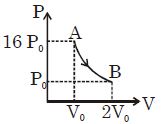
- 6Figure shows a polytropic process for an ideal gas. The work done by the gas will be in process $AB$ isView Solution
- 7View SolutionHeat is not being exchanged in a body. If its internal energy is increased, then
- 8Given below are two statementView Solution
Statement $-I$ : What $\mu$ amount of an ideal gas undergoes adiabatic change from state $\left( P _{1}, V _{1}, T _{1}\right)$ to state $\left( P _{2}, V _{2}, T _{2}\right)$, the work done is $W =\frac{1 R \left( T _{2}- T _{1}\right)}{1-\gamma}$, where $\gamma=\frac{ C _{ P }}{ C _{ V }}$ and $R =$ universal gas constant,
Statement $-II$ : In the above case. when work is done on the gas. the temperature of the gas would rise.
Choose the correct answer from the options given below
- 9The temperature of reservoir of Carnot's engine operating with an efficiency of $70\%$ is $1000K.$ The temperature of its sink is ...... $K$View Solution
- 10View SolutionIn the above thermodynamic process, the correct statement is