MCQ
A container, whose bottom has round holes with diameter $0.1$ $mm $ is filled with water. The maximum height in cm upto which water can be filled without leakage will be ........ $cm$

Surface tension $= 75 \times 10^{-3}$ $ N/m $  and $g = 10$ $ m/s^2$:

  • A
    $20$
  • B
    $40$
  • $30 $
  • D
    $60$

Answer

Correct option: C.
$30 $
c
Pressure $=\frac{2 T}{R}=\rho g h$

$\Rightarrow \frac{2 \times 75 \times 10^{-3}}{0.05 \times 10^{-3}}=10^{3} \times 10 \times h$

$\Rightarrow 3000=10^{3} \times 10 \times h$

$\Rightarrow h=0.3 m=30 \mathrm{cm}$

Need a full question paper?

Generate a complete, print-ready paper with questions like this in minutes — across 16+ boards, with answer keys.

Start Generating Free

Similar questions

A wave represented by the equation $y_1 = a\,cos(Kx-\omega t)$ is superimposed with another wave to form a stationary wave such that the point $x = 0$ is a node. The equation for the other wave is
A particle of mass $9.1 \times 10^{-31}\, {kg}$ travels in a medium with a speed of $10^{6}\, {m} / {s}$ and a photon of a radiation of linear momentum $10^{-27} \,{kg}\, {m} / {s}$ travels in vacuum. The wavelength of photon is $....$ times the wavelength of the particle.
Given below are two statements:

Statement $I$ : Acidity of $\alpha$-hydrogens of aldehydes and ketones is responsible for Aldol reaction.

Statement $II$ : Reaction between benzaldehyde and ethanal will $NOT$ give Cross - Aldol product. In the light of above statements, choose the most appropriate answer from the options given below.

Transformer $\rightarrow$ ideal $\rightarrow E _{ p }=1000\, V , I _{ p }=50\, A ,$ $220 V \rightarrow 80$ houses resistances of secondary coil will be (in $\Omega$)
If the density of the material increases, the value of Young's modulus
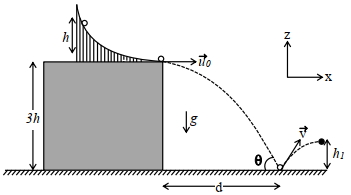
A slide with a frictionless curved surface, which becomes horizontal at its lower end,, is fixed on the terrace of a building of height $3 h$ from the ground, as shown in the figure. A spherical ball of mass $\mathrm{m}$ is released on the slide from rest at a height $h$ from the top of the terrace. The ball leaves the slide with a velocity $\vec{u}_0=u_0 \hat{x}$ and falls on the ground at a distance $d$ from the building making an angle $\theta$ with the horizontal. It bounces off with a velocity $\overrightarrow{\mathrm{v}}$ and reaches a maximum height $h_l$. The acceleration due to gravity is $g$ and the coefficient of restitution of the ground is $1 / \sqrt{3}$. Which of the following statement($s$) is(are) correct?

($AV$) $\vec{u}_0=\sqrt{2 g h} \hat{x}$ ($B$) $\vec{v}=\sqrt{2 g h}(\hat{x}-\hat{z})$  ($C$) $\theta=60^{\circ}$  ($D$) $d / h_1=2 \sqrt{3}$

What is the fractional error in $g$ calculated from $T = 2\pi \sqrt {l/g} $ ? Given fraction errors in $T$ and $l$ are $ \pm x$ and $ \pm y$ respectively?
Interference fringes were produced in Young's double slit experiment using light of wavelength $5000\,\mathop A\limits^o $. When a film of material $2.5\times10^{-3}\, cm$ thick was placed over one of the slits, the fringe pattern shifted by a distance equal to $20$ fringe widths. The refractive index of the material of the film is
A wire $100\,cm$ long and $2.0\,mm$ diameter has a resistance of $0.7\, ohm$, the electrical resistivity of the material is  ...........$ \times {10^{ - 6}}\,ohm \times m$
Fusion reaction is initiated with the help of