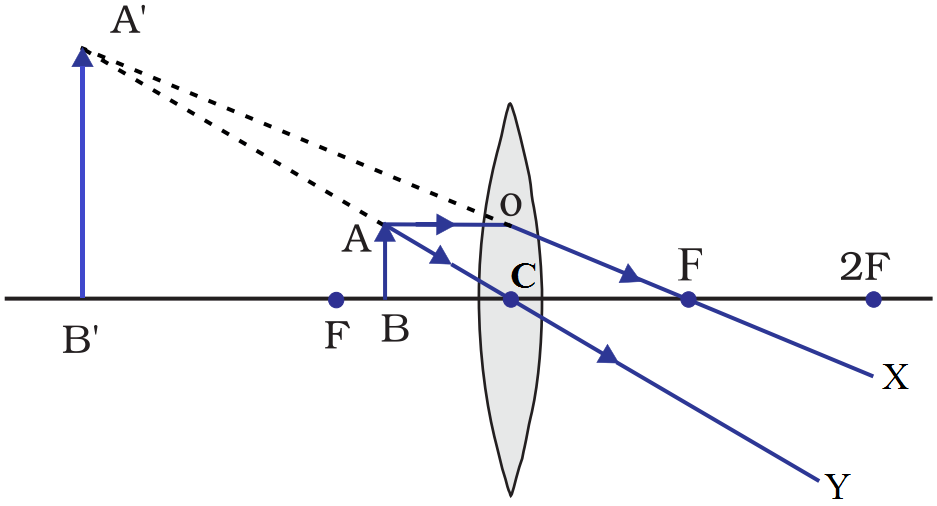
A convex lens of focal length 20cm can produce a magnified virtual as well as real image. Is this a correct statement? If yes, where shall the object be placed in each case for obtaining these images?
Download our app for free and get started
Yes, the statement is correct. The convex lens of focal length 20cm can produce a magnified, virtual as well as real image. The object should be placed Between focus $F_1$ and optical centre O (i.e., a distance less than 20cm from the lens) for magnified, virtual and erect image.

Download our appand get started for free
Experience the future of education. Simply download our apps or reach out to us for more information. Let's shape the future of learning together!No signup needed.*
Similar Questions
- 1View SolutionWhat is a lens? Distinguish between a convex lens and a concave lens. Which of the two is a converging lens : convex lens or concave lens?
- 2View SolutionAn arrow 2.5cm high is placed at a distance of 25cm from a diverging mirror of focal length 20cm. Find the nature, position and size of the image formed.
- 3View SolutionWhy does a ray falling normally on a plane mirror, retrace its path?
- 4View SolutionThe magnification of an image formed by a lens is –1. If the distance between the object and its image is 60cm, what is the distance of the object from the optical centre of the lens? Find the nature and focal length of the lens. If the object is displaced 20cm towards the optical centre of the lens, where would the image be formed and what would be its nature? Draw a ray diagram to justify your answer.
- 5Define Snell’s law of refraction. A ray of light is incident on a glass slab at an angle of incidence of 60°. If the angle of refraction be 32.7°, calculate the refractive index of glass.$(\text{Given:}\ \sin60^\circ=0.866,\text{ and }\sin32.7^\circ=540)$View Solution
- 6View SolutionAn image formed on a screen is three times the size of the object. The object and screen are 80cm apart when the image is sharply focussed.
- State which type of lens is used.
- Calculate focal length of the lens.
- 7View SolutionThe diverging lens in part (a) is replaced by a converging lens also of focal length 100mm. The object remains in the same position and an image is formed by the converging lens. Compare two properties of this image with those of the image formed by the diverging lens in part (a).
- 8View SolutionAn object is placed at a distance of 10 cm from a convex mirror of focal length 15 cm. Find the position and nature of the image.
- 9View SolutionA ray of light travelling in air is incident on a rectangular glass block and emerges out into the air from the opposite face. Draw a labelled ray diagram to show the complete path of this ray of light. Mark the two points where the refraction of light takes place. What can you say about the final direction of ray of light?
- 10View SolutionState and explain the New Cartesian Sign Convention for spherical lenses.