A copper solid cube of $60\,\, mm$ side is subjected to a pressure of $2.5 \times 10^7\, Pa$. If the bulk modulus of copper is $1.25 \times 10^{11}\, N/m^2$, the change in the volume of cube is
Medium
Download our app for free and get started
$\mathrm{B}=-\frac{\Delta \mathrm{PV}}{\Delta \mathrm{V}} \Rightarrow \Delta \mathrm{V}=-\frac{\Delta \mathrm{PV}}{\mathrm{B}}$
$=-\frac{2.5 \times 10^{7}}{1.25 \times 10^{11}} \times(60)^{3} \mathrm{mm}^{3}=-43.2 \mathrm{mm}^{3}$

Download our appand get started for free
Experience the future of education. Simply download our apps or reach out to us for more information. Let's shape the future of learning together!No signup needed.*
Similar Questions
- 1Wires $A$ and $B$ are made from the same material. $A$ has twice the diameter and three times the length of $B.$ If the elastic limits are not reached, when each is stretched by the same tension, the ratio of energy stored in $A$ to that in $B$ isView Solution
- 2A compressive force, $F$ is applied at the two ends of a long thin steel rod. It is heated, simultaneously, such that its temperature increases by $\Delta T$. The net change in its length is zero. Let $l$ be the length of the rod, $A$ its area of cross- section, $Y$ its Young's modulus, and $\alpha $ its coefficient of linear expansion. Then, $F$ is equal toView Solution
- 3A rubber cord $10\, m$ long is suspended vertically. How much does it stretch under its own weight $($Density of rubber is $1500\, kg/m^3, Y = 5×10^8 N/m^2, g = 10 m/s^2$$)$View Solution
- 4View SolutionA solid expands upon heating because
- 5View SolutionIf the density of the material increases, the value of Young's modulus
- 6A steel wire of diameter $2 \,mm$ has a breaking strength of $4 \times 10^5 \,N$.the breaking force ......... $\times 10^5 \,N$ of similar steel wire of diameter $1.5 \,mm$ ?View Solution
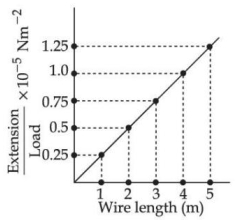
- 7In an experiment to determine the Young's modulus, steel wires of five different lengths $(1,2,3,4$ and $5\,m )$ but of same cross section $\left(2\,mm ^{2}\right)$ were taken and curves between extension and load were obtained. The slope (extension/load) of the curves were plotted with the wire length and the following graph is obtained. If the Young's modulus of given steel wires is $x \times 10^{11}\,Nm ^{-2}$, then the value of $x$ isView Solution
- 8An Indian rubber cord $L$ metre long and area of cross-section $A$ $metr{e^2}$ is suspended vertically. Density of rubber is $D$ $kg/metr{e^3}$ and Young's modulus of rubber is $E$ $newton/metr{e^2}$. If the wire extends by $l$ metre under its own weight, then extension $l$ isView Solution
- 9If the potential energy of a spring is $V$ on stretching it by $2\, cm$, then its potential energy when it is stretched by $10 \,cm$ will beView Solution
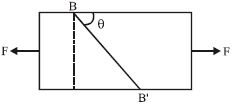
- 10A bar of cross-sectional area $A$ is subjected two equal and opposite tensile forces at its ends as shown in figure. Consider a plane $BB'$ making an angle $\theta $ with the length The ratio of tensile stress to the shearing stress on the plane $BB'$ isView Solution