MCQ
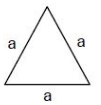
A copper wire is wound on a wooden frame, whose shape is that of an equilateral triangle. If the linear dimension of each side of the frame is increased by a factor of $3$, keeping the number of turns of the coil per unit length of the frame the same, then self inductance of the coil
  • A
    decreases by a factor of $9$
  • B
    increases by a factor of $27$
  • increases by a factor of $3$
  • D
    decreases by a factor of $9\sqrt 3 $

Answer

Correct option: C.
increases by a factor of $3$
c
Total length $L$ will remain constant

$\mathrm{L}=(3 \mathrm{a}) \mathrm{N} \quad(\mathrm{N}=\text { total tums })$

And length of winding $=(d) N=\ell$

$(d=\text { diameter of wire })$

Self inductance $=\mu_{0} \mathrm{n}^{2} \mathrm{A} \ell$

$=\mu_{0} n^{2}\left(\frac{\sqrt{3} a^{2}}{4}\right) d N$

$\alpha a^{2} N \propto a$

So self inductance will become $3$ times.

Need a full question paper?

Generate a complete, print-ready paper with questions like this in minutes — across 16+ boards, with answer keys.

Start Generating Free

Similar questions

Water is flowing through a horizontal tube having cross-sectional areas of its two ends being $A$ and $A'$ such that the ratio $A/A'$ is $5$ છે.જો  If the pressure difference of water between the two ends is $3 \times 10^5\, N\, m^{-2}$, the velocity of water with which it enters the tube will be ......... $m s^{-1}$ (neglect gravity effects)
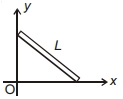
A rod of length $L$ leans against a smooth vertical wall while its other end is on a smooth floor. The end that leans against the wall moves uniformly vertically downward. Select the correct alternative
A body of mass $m_1$ exerts a force on another body of mass $m_2$. If the magnitude of acceleration of $m_2$ is $a_2$, then the magnitude of the acceleration of $m_1$ is (considering only two bodies in space)
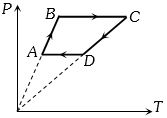
Six moles of an ideal gas perfomrs a cycle shown in figure. If the temperature are $T_A = 600 K, T_B = 800 K, T_C = 2200 K \,and\, T_D = 1200 K$, the work done per cycle is ..... $kJ$
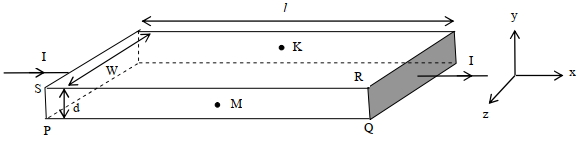
In a thin rectangular metallic strip a constant current $I$ flows along the positive $x$-direction, as shown in the figure. The length, width and thickness of the strip are $\ell$, w and $d$, respectively. A uniform magnetic field $\vec{B}$ is applied on the strip along the positive $y$-direction. Due to this, the charge carriers experience a net deflection along the $z$ direction. This results in accumulation of charge carriers on the surface $P Q R S$ and appearance of equal and opposite charges on the face opposite to $PQRS$. A potential difference along the $z$-direction is thus developed. Charge accumulation continues until the magnetic force is balanced by the electric force. The current is assumed to be uniformly distributed on the cross section of the strip and carried by electrons.

$1.$ Consider two different metallic strips ($1$ and $2$) of the same material. Their lengths are the same, widths are $w_1$ and $w_2$ and thicknesses are $d_1$ and $d_2$, respectively. Two points $K$ and $M$ are symmetrically located on the opposite faces parallel to the $x$ - $y$ plane (see figure). $V _1$ and $V _2$ are the potential differences between $K$ and $M$ in strips $1$ and $2$ , respectively. Then, for a given current $I$ flowing through them in a given magnetic field strength $B$, the correct statement$(s)$ is(are)

$(A)$ If $w _1= w _2$ and $d _1=2 d _2$, then $V _2=2 V _1$

$(B)$ If $w_1=w_2$ and $d_1=2 d_2$, then $V_2=V_1$

$(C)$ If $w _1=2 w _2$ and $d _1= d _2$, then $V _2=2 V _1$

$(D)$ If $w _1=2 w _2$ and $d _1= d _2$, then $V _2= V _1$

$2.$ Consider two different metallic strips ($1$ and $2$) of same dimensions (lengths $\ell$, width w and thickness $d$ ) with carrier densities $n_1$ and $n_2$, respectively. Strip $1$ is placed in magnetic field $B_1$ and strip $2$ is placed in magnetic field $B_2$, both along positive $y$-directions. Then $V_1$ and $V_2$ are the potential differences developed between $K$ and $M$ in strips $1$ and $2$, respectively. Assuming that the current $I$ is the same for both the strips, the correct option$(s)$ is(are)

$(A)$ If $B_1=B_2$ and $n_1=2 n_2$, then $V_2=2 V_1$

$(B)$ If $B_1=B_2$ and $n_1=2 n_2$, then $V_2=V_1$

$(C)$ If $B _1=2 B _2$ and $n _1= n _2$, then $V _2=0.5 V _1$

$(D)$ If $B_1=2 B_2$ and $n_1=n_2$, then $V_2=V_1$

Give the answer question $1$ and $2.$ 
Ametal wire is clamped between two vertical walls.At $20 ^o C$ the unstrained length of the wire is exactly equal to the separation between walls. If the temperature of the wire is decreased the graph between elastic energy density $(u)$ and temperature $(T)$ of the wire is
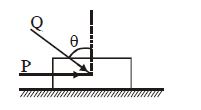
A block of mass $m$ lying on a rough horizontal plane is acted upon by a horizontal force $P$ and another force $Q$ inclined an at an angle $\theta $ to the vertical. The minimum value of coefficient of friction between the block and the surface for which the block will remain in equilibrium is
A particle is made to move from the origin in three spells of equal distances, first along the $x-axis$ , second parallel to $y-axis$ and third parallel to $z-axis$ . One of the forces acting on it is has constant magnitude of $50\  N$ and always acts along the direction of motion. Work done by this force in the three spells of motion are equal and total work done in all the three spells is $300\ J$ . The final coordinates of the particle will be
The force on a particle as the function of displacement x (in $x-$ direction) is given by $F = 10 + 0.5x$ The work done corresponding to displacement of particle from $x = 0$ to $x = 2$ unit is
In the Young's double slit experiment, the intensities at two points  $P_1$  and  $P_2$  on the screen are respectively $I_1$  and $I_2$ . If $P_1$  is located at the centre of a bright fringe and $P_2$  is located at a distance equal to a quarter of fringe width from $P_1$  then $\frac {I_1}{I_2}$ is