Water is flowing through a horizontal tube having cross-sectional areas of its two ends being $A$ and $A'$ such that the ratio $A/A'$ is $5$ છે.જો If the pressure difference of water between the two ends is $3 \times 10^5\, N\, m^{-2}$, the velocity of water with which it enters the tube will be ......... $m s^{-1}$ (neglect gravity effects)
AIEEE 2012Diffcult
Download our app for free and get started
According to $Bernoulli's$ theorem
${P_1} + \frac{1}{2}\rho v_1^2 = {P_2} + \frac{1}{2}\rho v_2^2\,\,\,...\left( i \right)$
From question,
${P_1} - {P_2} = 3 \times {10^5},\frac{{{A_1}}}{{{A_2}}} = 5$
According to equation of constinuity
${A_1}{v_1} = {A_2}{v_2}$
$or,\frac{{{A_1}}}{{{A_2}}} = \frac{{{v_2}}}{{{v_1}}} = 5$
$ \Rightarrow \,\,{v_2} = 5{v_1}$
From equation $(i)$
${P_1} - {P_2} = \frac{1}{2}\rho \left( {v_2^2 - v_1^2} \right)$
$or\,\,3 \times {10^5} = \frac{1}{2} \times 1000\left( {5v_1^2 - v_1^2} \right.$
$ \Rightarrow 600 = 6{v_1} \times 4{v_1}$
$ \Rightarrow v_1^2 = 25$
$\therefore \,{v_1} = 5\,m/s$

Download our appand get started for free
Experience the future of education. Simply download our apps or reach out to us for more information. Let's shape the future of learning together!No signup needed.*
Similar Questions
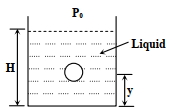
- 1A small spherical monoatomic ideal gas bubble $\left(\gamma=\frac{5}{3}\right)$ is trapped inside a liquid of density $\rho_{\ell}$ (see figure). Assume that the bubble does not exchange any heat with the liquid. The bubble contains n moles of gas. The temperature of the gas when the bubble is at the bottom is $\mathrm{T}_0$, the height of the liquid is $\mathrm{H}$ and the atmospheric pressure is $\mathrm{P}_0$ (Neglect surface tension).View Solution
Figure: $Image$
$1.$ As the bubble moves upwards, besides the buoyancy force the following forces are acting on it
$(A)$ Only the force of gravity
$(B)$ The force due to gravity and the force due to the pressure of the liquid
$(C)$ The force due to gravity, the force due to the pressure of the liquid and the force due to viscosity of the liquid
$(D)$ The force due to gravity and the force due to viscosity of the liquid
$2.$ When the gas bubble is at a height $\mathrm{y}$ from the bottom, its temperature is
$(A)$ $\mathrm{T}_0\left(\frac{\mathrm{P}_0+\rho_0 \mathrm{gH}}{\mathrm{P}_0+\rho_t \mathrm{gy}}\right)^{2 / 5}$
$(B)$ $T_0\left(\frac{P_0+\rho_t g(H-y)}{P_0+\rho_t g H}\right)^{2 / 5}$
$(C)$ $\mathrm{T}_0\left(\frac{\mathrm{P}_0+\rho_t \mathrm{gH}}{\mathrm{P}_0+\rho_t \mathrm{gy}}\right)^{3 / 5}$
$(D)$ $T_0\left(\frac{P_0+\rho_t g(H-y)}{P_0+\rho_t g H}\right)^{3 / 5}$
$3.$ The buoyancy force acting on the gas bubble is (Assume $R$ is the universal gas constant)
$(A)$ $\rho_t \mathrm{nRgT}_0 \frac{\left(\mathrm{P}_0+\rho_t \mathrm{gH}\right)^{2 / 5}}{\left(\mathrm{P}_0+\rho_t \mathrm{gy}\right)^{7 / 5}}$
$(B)$ $\frac{\rho_{\ell} \mathrm{nRgT}_0}{\left(\mathrm{P}_0+\rho_{\ell} \mathrm{gH}\right)^{2 / 5}\left[\mathrm{P}_0+\rho_{\ell} \mathrm{g}(\mathrm{H}-\mathrm{y})\right]^{3 / 5}}$
$(C)$ $\rho_t \mathrm{nRgT} \frac{\left(\mathrm{P}_0+\rho_t g \mathrm{H}\right)^{3 / 5}}{\left(\mathrm{P}_0+\rho_t g \mathrm{~g}\right)^{8 / 5}}$
$(D)$ $\frac{\rho_{\ell} \mathrm{nRgT}_0}{\left(\mathrm{P}_0+\rho_{\ell} \mathrm{gH}\right)^{3 / 5}\left[\mathrm{P}_0+\rho_t \mathrm{~g}(\mathrm{H}-\mathrm{y})\right]^{2 / 5}}$
Give the answer question $1,2,$ and $3.$
- 2A beaker containing water is placed on the platform of a spring balance. The balance reads $1.5$ $kg$. A stone of mass $0.5$ $kg$ and density $500$ $kg/m^3$ is immersed in water without touching the walls of beaker. What will be the balance reading now ? ..... $kg$View Solution
- 3A spherical solid ball of volume $V$ is made of a material of density $\rho_1$ . It is falling through a liquid of density $\rho_2 (\rho_2 < \rho_1 )$. Assume that the liquid applies a viscous force on the ball that is proportional to the square of its speed $v$, i.e., $F_{viscous}= -kv^2 (k >0 )$,The terminal speed of the ball isView Solution
- 4We have three beakers $A, B$ and $ C $ containing glycerine, water and kerosene respectively. They are stirred vigorously and placed on a table. The liquid which comes to rest at the earliest isView Solution
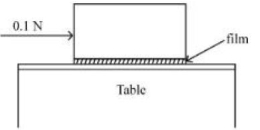
- 5A metal block of base area $0.20\,m ^2$ is placed on a table, as shown in figure. A liquid film of thickness $0.25\,mm$ is inserted between the block and the table. The block is pushed by a horizontal force of $0.1\,N$ and moves with a constant speed. If the viscosity of the liquid is $5.0 \times 10^{-3} \;Pa-s$, the speed of block is $.........\times 10^{-3}\,m / s$View Solution
- 6A $U-$ tube containing a liquid moves with a horizontal acceleration a along a direction joining the two vertical limbs. The separation between these limbs is $d$ . The difference in their liquid levels isView Solution
- 7A Newtonian fluid fills the clearance between a shaft and a sleeve. When a force of $800$ $N$ is applied to the shaft, parallel to the sleeve, the shaft attains a speed of $1.5$ $cm/sec$. If a force of $2.4$ $kN$ is applied instead, the shaft would move with a speed of ......... $ cm/sec$View Solution
- 8View SolutionThe Reynolds number of a flow is the ratio of
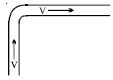
- 9A fire hydrant delivers water of density $\rho$ at a volume rate $L$. The water travels vertically upward through the hydrant and then does $90^o $ turn to emerge horizontally at speed $V$. The pipe and nozzle have uniform crosssection throughout. The force exerted by the water on the corner of the hydrant isView Solution
- 10Water is moving with a speed of $5.0\,m/s$ through a pipe of cross sectional area $4.0\,cm^2$ . The water gradually descends $10\,m$ as the pipe increase in area to $8.0\,cm^2$ . If the pressure at the upper level is $1.5 \times 10^5\,Pa$ , the pressure at lower level will beView Solution