In the three states of matter, the elastic coefficient can be
Easy


Download our appand get started for free
Experience the future of education. Simply download our apps or reach out to us for more information. Let's shape the future of learning together!No signup needed.*
Similar Questions
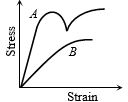
- 1The diagram shows stress v/s strain curve for the materials $A$ and $B$. From the curves we infer thatView Solution
- 2The mass and length of a wire are $M$ and $L$ respectively. The density of the material of the wire is $d$. On applying the force $F$ on the wire, the increase in length is $l$, then the Young's modulus of the material of the wire will beView Solution
- 3The Young's modulus of the material of a wire is $6 \times {10^{12}}\,N/{m^2}$ and there is no transverse strain in it, then its modulus of rigidity will beView Solution
- 4The Young's modulus of a steel wire of length $6\,m$ and cross-sectional area $3\,mm ^2$, is $2 \times 11^{11}\,N / m ^2$. The wire is suspended from its support on a given planet. A block of mass $4\,kg$ is attached to the free end of the wire. The acceleration due to gravity on the planet is $\frac{1}{4}$ of its value on the earth. The elongation of wire is (Take $g$ on the earth $=10$ $\left.m / s ^2\right):$View Solution
- 5The length of wire becomes $l_1$ and $l_2$ when $100\,N$ and $120\,N$ tensions are applied respectively. If $10l_2=11l_1$, the natural length of wire will be $\frac{1}{x} l_1$. Here the value of $x$ is ........View Solution
- 6The maximum elongation of a steel wire of $1 \mathrm{~m}$ length if the elastic limit of steel and its Young's modulus, respectively, are $8 \times 10^8 \mathrm{~N} \mathrm{~m}^{-2}$ and $2 \times 10^{11} \mathrm{~N} \mathrm{~m}^{-2}$, is:View Solution
- 7Find the depth of lake at which density of water is $1\%$ greater than at the surface. Given compressibility ........... $km$ . $K = 50\times10^{-6}/atm$ ?View Solution
- 8A force $F$ is applied on the wire of radius $r$ and length $L$ and change in the length of wire is $l.$ If the same force $F$ is applied on the wire of the same material and radius $2r$ and length $2L,$ Then the change in length of the other wire isView Solution
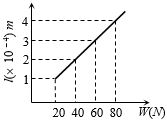
- 9The adjacent graph shows the extension $(\Delta l)$ of a wire of length $1m$ suspended from the top of a roof at one end with a load $W$ connected to the other end. If the cross sectional area of the wire is ${10^{ - 6}}{m^2},$ calculate the young’s modulus of the material of the wireView Solution
- 10Work done by restoring force in a string within elastic limit is $-10 \,J$. Maximum amount of heat produced in the string is .......... $J$View Solution