MCQ
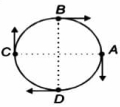
A couple produces a:
  • A
    Pure linear motion.
  • B
    Pure rotational motion.
  • C
    None of the above.
  • D
    Both linear and rotational motion.

Answer

  1. Pure rotational motion.

Need a full question paper?

Generate a complete, print-ready paper with questions like this in minutes — across 16+ boards, with answer keys.

Start Generating Free

Similar questions

An isolated rail car of mass $M$ is moving along a straight, frictionless track at an initial speed $v_0$. The car is passing under a bridge when $a$ crate filled with $N$ bowling balls, each of mass $m$, is dropped from the bridge into the bed of the rail car. The crate splits open and the bowling balls bounce around inside the rail car, but none of them fall out. Is the momentum of the rail car $+$ bowling balls system conserved in this collision?
The force required to punch a square hole $2\,cm$ side in steel sheet $2\,mm$ thick is (shearing stress of steel sheet $= 3.5\times 10^8\,\,N/m^2$ )
A thin and uniform rod of mass $M$ and length $L$ is held vertical on a floor with large friction. The rod is released from rest so that it falls by rotating about its contact-point with the floor without slipping. Which of the following statement($s$) is/are correct, when the rod makes an angle $60^{\circ}$ with vertical ? [ $g$ is the acceleration due to gravity]

$(1)$ The radial acceleration of the rod's center of mass will be $\frac{3 g }{4}$

$(2)$ The angular acceleration of the rod will be $\frac{2 g }{ L }$

$(3)$ The angular speed of the rod will be $\sqrt{\frac{3 g}{2 L}}$

$(4)$ The normal reaction force from the floor on the rod will be $\frac{ Mg }{16}$
A river is flowing from east to west at a speed of $5\, m/min$ A man on south bank of river, capable of swimming $10\,m/min$ in still water, wants to swim across the river in shortest time. He should swim
A monoatomic gas $\left( {\gamma  = \frac{5}{3}} \right)$ is suddenly compressed to $\frac{1}{8}$ of its original volume, then the pressure of gas will change to how many times the initial pressure?
A particle of unit mass undergoes one­ dimensional motion such that its velocity varies according to $ v(x)= \beta {x^{ - 2n}}$, where $\beta$ and $n$ are constants and $x$ is the position of the particle. The acceleration of the particle as a function of $x$, is given by
Four particles $A, B, C$ and $D$ are moving with constant speed $v$ each. At the instant shown relative velocity of $A$ with respect to $B, C$ and $D$ are in directions
In isothermal, isobaric and adiabatic processes, the value of work done for equal volume change is minimum:
If a ball of steel (density $\rho=7.8 \;gcm ^{-3}$) attains a terminal velocity of $10 \;cms ^{-1}$ when falling in a tank of water (coefficient of viscosity $\eta_{\text {water }}=8.5 \times 10^{-4} \;Pa - s$ ) then its terminal velocity in glycerine $\left(\rho=12 gcm ^{-3}, \eta=13.2\right)$ would be nearly
The source producing sound and an observer both are moving along the direction of propagation of sound waves. If the respective velocities of sound, source and an observer are $v,  {v_s}$ and ${v_o}$, then the apparent frequency heard by the observer will be ($n =$ frequency of sound)