Question
A cricketer can throw a ball to a maximum horizontal distance of 100m. How much high above the ground can the cricketer throw the same ball?

Answer

Maximum horizontal distance, R = 100m The cricketer will only be able to throw the ball to the maximum horizontal distance when the angle of projection is $45^\circ,\text{i.e.,}\theta=45^\circ.$ The horizontal range for a projection velocity v, is given by the relation: $\text{R}=\text{u}^2\sin2\theta/\text{g}$ $100=\text{u}^2\sin90^\circ/\text{g}$ $\frac{\text{u}^2}{\text{g}}=100\ ...(\text{i})$ The ball will achieve the maximum height when it is thrown vertically upward. For such motion, the final velocity v is zero at the maximum height H. Acceleration, a = -g Using the third equation of motion: $\text{v}^2-\text{u}^2=-2\text{gH}$ $\text{H}=\frac{\text{u}^2}{2\text{g}}=\frac{100}{2}=50\text{m}$

Need a full question paper?

Generate a complete, print-ready paper with questions like this in minutes — across 16+ boards, with answer keys.
Start Generating Free

Similar questions

A spherical ball A of surface area $20cm^2$ is kept at the centre of a hollow spherical shell B of area $80cm^2$. The surface of A and the inner surface of B emit as blackbodies. Both A and B are at $300K$.
  1. How much is the radiation energy emitted per second by the ball A?
  2. How much is the radiation energy emitted per second by the inner surface of B
  3. How much of the energy emitted by the inner surface of B falls back on this surface itself?
A uniform magnetic field B exist in a region. An electron projected perpendicular to the field goes in a circle. Assuming Bohr's quantization rule for angular momentum, calculate (a) the smallest possible radius of the electron (b) the radius of the nth orbit and (c) the minimum possible speed of the electron.
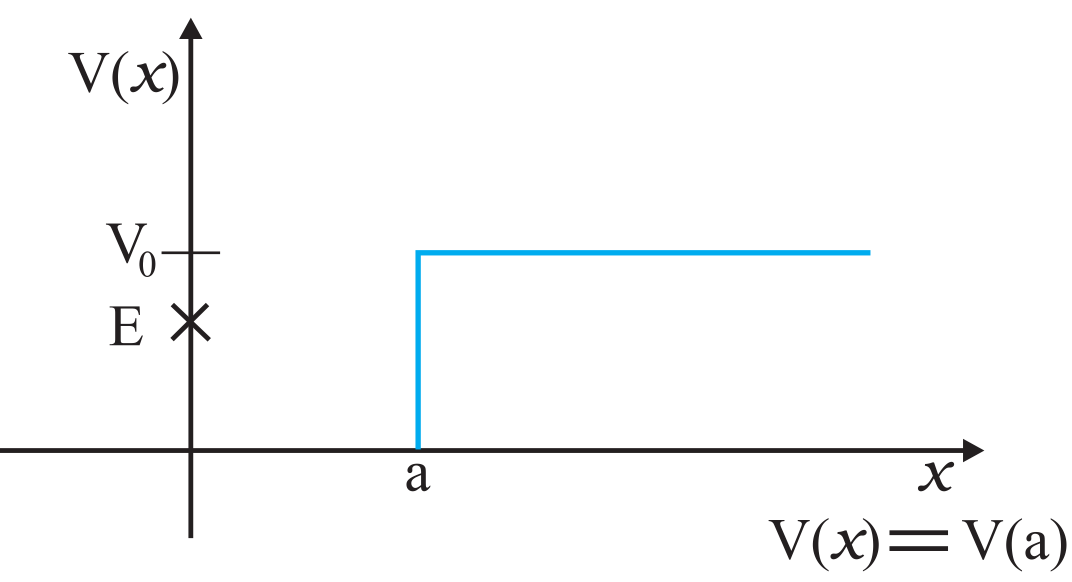
Given in are examples of some potential energy functions in one dimension. The total energy of the particle is indicated by a cross on the ordinate axis. In each case, specify the regions, if any, in which the particle cannot be found for the given energy. Also, indicate the minimum total energy the particle must have in each case. Think of simple physical contexts for which these potential energy shapes are relevan.
The speed of a train increases at a constant rate a from zero to $\nu$ and then remains constant for an interval, and finally decreases to zero at a constant rate $\beta.$ If L be the total distance described prove that the total time taken is $\frac{\text{L}}{\nu}+\frac{\nu}{2}\Big(\frac{1}{\alpha}+\frac{1}{\beta}\Big).$
The ratio of the coefficients of thermal conductivity of two different materials is 4 : 3. If the thermal resistance of the rods of the same thickness of these materials is same, then what is the ratio of the lengths of these rods?
Explain the velocity of sound in different medium and write the factor affecting the velocity of sound in gas.
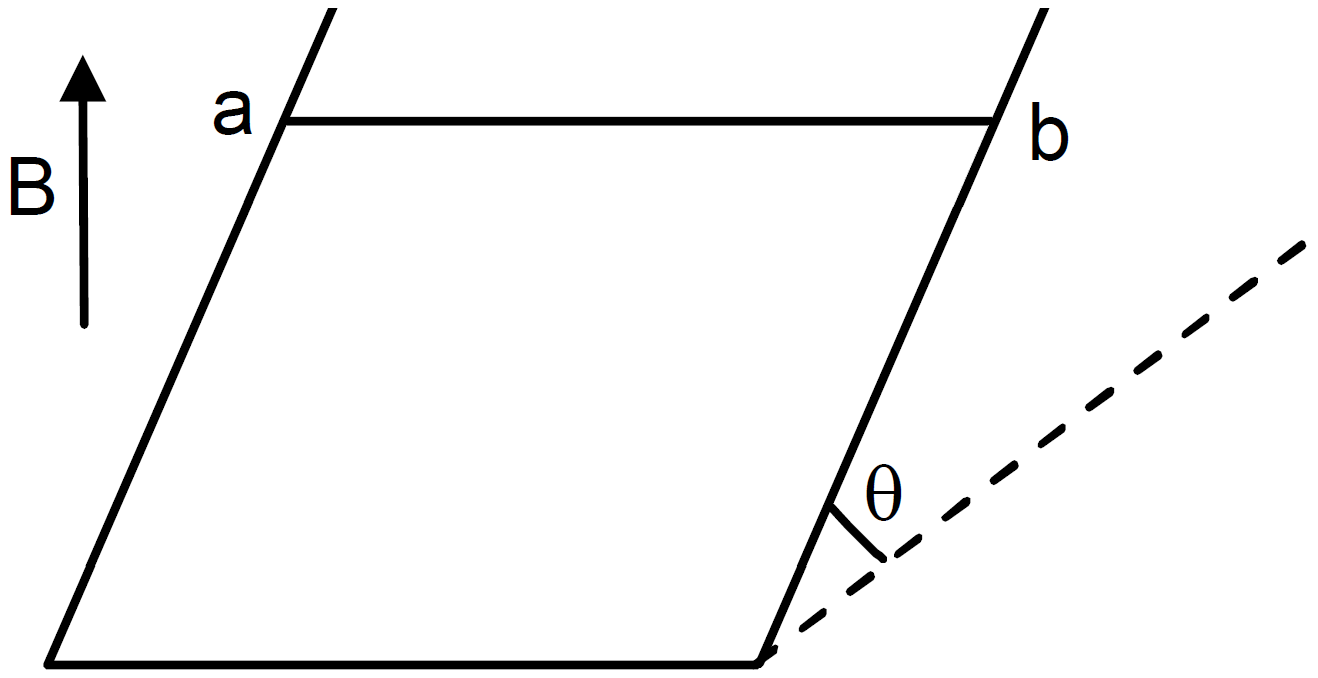
A wire ab of length l, mass m and resistance R slides on a smooth, thick pair of metallic rails joined at the bottom as shown in figure. The plane of the rails makes an angle θ with the horizontal. A vertical magnetic field B exists in the region. If the wire slides on the rails at a constant speed v, show that$\text{B}=\sqrt{\frac{\text{mgR}\sin\theta}{\text{vl}^2\cos^2\theta}}$
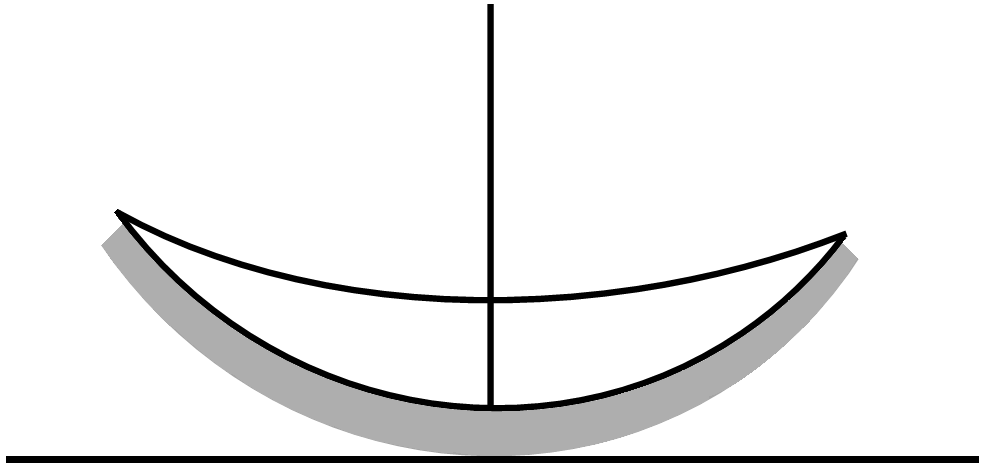
The convex surface of a thin concavo-convex lens of glass of refractive index $1.5$ has a radius of curvature $20cm$. The concave surface has a radius of curvature $60cm$. The convex side is silvered and placed on a horizontal surface as shown in figure.
  1. Where should a pin be placed on the axis so that its image is formed at the same place?
  2. If the concave part is filled with water $\Big(\mu=\frac{4}{3}\Big),$ find the distance through which the pin should be moved so that the image of the pin again coincides with the pin.
Define the term orbital speed. Establish a relation for orbital speed of a satellite orbiting very close to the surface of the earth. Find the ratio of this orbital speed and escape speed.
A family uses $8kW$ of power.
  1. Direct solar energy is incident on the horizontal surface at an average rate of $200W$ per square meter. If $20\%$ of this energy can be converted to useful electrical energy, how large an area is needed to supply $8kW$?
  2. Compare this area to that of the roof of a typical house.