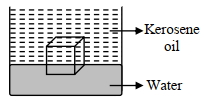
A cube of ice floats partly in water and partly in kerosene oil. The radio of volume of ice immersed in water to that in kerosene oil (specific gravity of Kerosene oil $=0.8$, specific gravity of ice $=0.9$ )
JEE MAIN 2024, Diffcult
Download our app for free and get started
$\mathrm{v}_1=\text { volume immersed in water. }$
$\mathrm{v}_2=\text { volume immersed in oil. }$
$\mathrm{v}_1 \rho_{\mathrm{w}} \mathrm{g}+\mathrm{v}_2 \rho_{\mathrm{o}} \mathrm{g}=\left(\mathrm{v}_1+\mathrm{v}_2\right) \rho_{\mathrm{c}} \mathrm{g}$
$\mathrm{v}_1+\frac{\mathrm{v}_2 \rho_0}{\rho_w}=\left(\mathrm{v}_1+\mathrm{v}_2\right) \frac{\rho_{\mathrm{c}}}{\rho_w}$
$=\mathrm{v}_1+0.8 \mathrm{v}_2=0.9 \mathrm{v}_1+0.9 \mathrm{v}_2$
$=0.1 \mathrm{v}_1=0.1 \mathrm{v}_2$
$\mathrm{v}_1: \mathrm{v}_2=1: 1$

Download our appand get started for free
Experience the future of education. Simply download our apps or reach out to us for more information. Let's shape the future of learning together!No signup needed.*
Similar Questions
- 1A plane is in level flight at constant speed and each of its two wings has an area of $25 \;m ^{2}$ If the speed of the air is $180 \;km / h$ over the lower wing and $234\; km / h$ over the upper wing surface, determine the plane's mass in $kg$. (Take air density to be $1\; kg m ^{-3}$ ).View Solution
- 2A ball of mass $m$ and radius $ r $ is gently released in a viscous liquid. The mass of the liquid displaced by it is $m' $ such that $m > m'$. The terminal velocity is proportional toView Solution
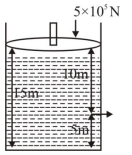
- 3Consider a cylindrical tank of radius $1 m$ is filled with water. The top surface of water is at $15\,m$ from the bottom of the cylinder. There is a hole on the wall of cylinder at a height of $5\,m$ from the bottom. A force of $5 \times 10^{5} N$ is applied an the top surface of water using a piston. The speed of efflux from the hole will be.View Solution
(given atmospheric pressure $P_{A}=1.01 \times 10^{5}\,Pa$, density of water $\rho_{ w }=1000\,kg / m ^{3}$ and gravitational acceleration $g=10\,m / s ^{2}$ )
- 4At what speed the velocity head of a stream of water be equal to $40 cm $ of $Hg$ ........ $cm/sec$View Solution
- 5A uniform cylinder of length $L$ and mass $M$ having crosssectional area $A$ is suspended, with its length vertical, from a fixed point by a massless spring such that it is half submerged in a liquid of density $\sigma$ at equilibrium position. The extension $x_0$ of the spring when it is in equilibrium isView Solution
- 6A small wooden ball of density $ \rho$ is immersed in water of density $\sigma $ to depth $h $ and then released. The height $H$ above the surface of water up to which the ball will jump out of water isView Solution
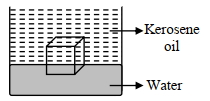
- 7A cube of ice floats partly in water and partly in kerosene oil. The radio of volume of ice immersed in water to that in kerosene oil (specific gravity of Kerosene oil $=0.8$, specific gravity of ice $=0.9$ )View Solution
- 8View SolutionWater falls from a tap, down the streamline
- 9Three identical vessels are filled to the same height with three different liquids $A, B$ and $C$ $({\rho _A} > {\rho _B} > {\rho _C})$. The pressure at the base will beView Solution
- 10The cylindrical tube of a spray pump has radius $R,$ one end of which has $n$ fine holes, each of radius $r.$ If the speed of the liquid in the tube is $v,$ the speed of the ejection of the liquid through the holes isView Solution