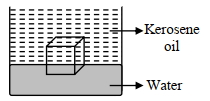
A cube of ice floats partly in water and partly in kerosene oil. The radio of volume of ice immersed in water to that in kerosene oil (specific gravity of Kerosene oil $=0.8$, specific gravity of ice $=0.9$ )
JEE MAIN 2024, Diffcult


Download our appand get started for free
Experience the future of education. Simply download our apps or reach out to us for more information. Let's shape the future of learning together!No signup needed.*
Similar Questions
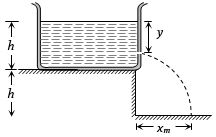
- 1A tank is filled upto a height $h$ with a liquid and is placed on a platform of height h from the ground. To get maximum range ${x_m}$ a small hole is punched at a distance of $y$ from the free surface of the liquid. ThenView Solution
- 2A wooden block floats in a liquid with $40\%$ of its volume inside the liquid. When the vessel containing he liquid starts rising upwards with acceleration $a = g/2$, the percentage of volume inside the liquid is ......... $\%$View Solution
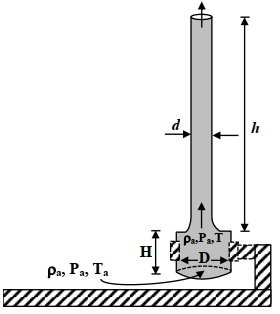
- 3A cylindrical furnace has height $(H)$ and diameter $(D)$ both $1 \mathrm{~m}$. It is maintained at temperature $360 \mathrm{~K}$. The air gets heated inside the furnace at constant pressure $P_a$ and its temperature becomes $T=360 \mathrm{~K}$. The hot air with density $\rho$ rises up a vertical chimney of diameter $d=0.1 \mathrm{~m}$ and height $h=9 \mathrm{~m}$ above the furnace and exits the chimney (see the figure). As a result, atmospheric air of density $\rho_a=1.2 \mathrm{~kg} \mathrm{~m}^{-3}$, pressure $P_a$ and temperature $T_a=300 \mathrm{~K}$ enters the furnace. Assume air as an ideal gas, neglect the variations in $\rho$ and $T$ inside the chimney and the furnace. Also ignore the viscous effects.View Solution
[Given: The acceleration due to gravity $g=10 \mathrm{~ms}^{-2}$ and $\pi=3.14$ ]
(image)
($1$) Considering the air flow to be streamline, the steady mass flow rate of air exiting the chimney is
. . . . .$\mathrm{gm} \mathrm{s}^{-1}$.
($2$) When the chimney is closed using a cap at the top, a pressure difference $\Delta P$ develops between the top and the bottom surfaces of the cap. If the changes in the temperature and density of the hot air, due to the stoppage of air flow, are negligible then the value of $\Delta P$ is. . . . .$\mathrm{Nm}^{-2}$.
- 4A leak proof cylinder of length $1 \;\mathrm{m},$ made of a metal which has very low coefficient of expansion is floating vertically in water at $0^{\circ} \mathrm{C}$ such that its height above the water surface is $20\; \mathrm{cm} .$ When the temperature of water is increased to $4^{\circ} \mathrm{C},$ the height of the cylinder above the water surface becomes $21 \;\mathrm{cm} .$ The density of water at $\mathrm{T}=4^{\circ} \mathrm{C},$ relative to the density at $\mathrm{T}=0^{\circ} \mathrm{C}$ is close toView Solution
- 5A sphere is dropped under gravity through a fluid of viscosity $\eta$ . If the average acceleration is half of the initial acceleration, the time to attain the terminal velocity is ($\rho$ = density of sphere ; $r$ = radius)View Solution
- 6At shallow depth $h$, the pressure in the ocean is simply given by $P = P_0 + \rho gh$, in which $\rho$ is the density of water and $P_0$ is the air pressure. As we go deeper, the high pressure causes the water to compress and become denser. Which of the following sketches illustrates the correct dependence of the pressure on the depth $h$ ?View Solution
- 7View SolutionWater flows out of the hole on the side of a bucket and follows a parabolic path. If the bucket falls freely under gravity, ignoring air resistance, the water flow
- 8View SolutionBernoulli’s principle is based on the law of conservation of
- 9An ornament weighs $10\, g$ in air and $6\, g$ in water. Density of material of ornament is $20\,\frac{g}{{cc}}$. The volume of cavity in ornament is ........ $cc$View Solution
- 10Karman line is a theoretical construct that separates the earth's atmosphere from outer space. It is defined to be the height at which the lift on an aircraft flying at the speed of a polar satellite $(8 \,km / s )$ is equal to its weight. Taking a fighter aircraft of wing area $30 \,m ^2$, and mass $7500 \,kg$, the height of the Karman line above the ground will be in the range .............. $km$ (assume the density of air at height $h$ above ground to be $\rho( h )=1.2 e ^{\frac{ h }{10}} \,kg / m ^3$ where $h$ is in $km$ and the lift force to be $\frac{1}{2} \rho v^2 A$, where $v$ is the speed of the aircraft and $A$ its wing area).View Solution