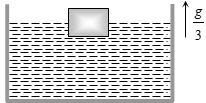
An ornament weighs $10\, g$ in air and $6\, g$ in water. Density of material of ornament is $20\,\frac{g}{{cc}}$. The volume of cavity in ornament is ........ $cc$
Medium


Download our appand get started for free
Experience the future of education. Simply download our apps or reach out to us for more information. Let's shape the future of learning together!No signup needed.*
Similar Questions
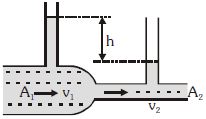
- 1A liquid flows through a horizontal tube. The velocities of the liquid in the two sections which have areas of cross-section $A_1$ and $A_2$ are $v_1$ and $v_2$ respectively. The difference in the levels of the liquid in the two vertical tubes is $h$ . The incorrect statement isView Solution
- 2A pressure-pump has a horizontal tube of cross-sectional area $10\,cm ^{2}$ for the outflow of water at a speed of $20\,m / s$. The force exerted on the vertical wall just in front of the tube which stops water horizontally flowing out of the tube, is $...N$ [given : density of water $=1000\,kg / m ^{3}$ ]View Solution
- 3A solid sphere, of radius $R$ acquires a terminal velocity $\nu_1 $ when falling (due to gravity) through a viscous fluid having a coefficient of viscosity $\eta $. The sphere is broken into $27$ identical solid spheres. If each of these spheres acquires a terminal velocity, $\nu_2$, when falling through the same fluid, the ratio $(\nu_1/\nu_2)$ equalsView Solution
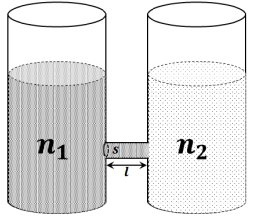
- 4As shown schematically in the figure, two vessels contain water solutions (at temperature $T$ ) of potassium permanganate $\left( KMnO _4\right)$ of different concentrations $n_1$ and $n_2\left(n_1>n_2\right)$ molecules per unit volume with $\Delta n=\left(n_1-n_2\right) \ll n_1$. When they are connected by a tube of small length $\ell$ and cross-sectional area $S , KMnO _4$ starts to diffuse from the left to the right vessel through the tube. Consider the collection of molecules to behave as dilute ideal gases and the difference in their partial pressure in the two vessels causing the diffusion. The speed $v$ of the molecules is limited by the viscous force $-\beta v$ on each molecule, where $\beta$ is a constant. Neglecting all terms of the order $(\Delta n)^2$, which of the following is/are correct? ( $k_B$ is the Boltzmann constant)-View Solution
$(A)$ the force causing the molecules to move across the tube is $\Delta n k_B T S$
$(B)$ force balance implies $n_1 \beta v \ell=\Delta n k_B T$
$(C)$ total number of molecules going across the tube per sec is $\left(\frac{\Delta n}{\ell}\right)\left(\frac{k_B T}{\beta}\right) S$
$(D)$ rate of molecules getting transferred through the tube does not change with time
- 5In a cylindrical container open to the atmosphere from the top a liquid is filled upto $10\,\, m$ depth. Density of the liquid varies with depth from the surface as $\rho (h) = 100 + 6h^2$ where $h$ is in meter and $\rho$ is in $kg/m^3.$ The pressure at the bottom of the container will be : $($ atmosphere pressure $= 10^5\,\, Pa, \,g = 10\, m/sec^2)$View Solution
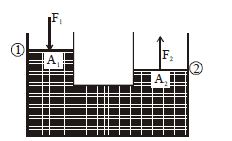
- 6The diagram below shows a hydraulic lift.A force is applied at $side\ 1$ and an output force is generated at $side\ 2$. Which of the following is true?View Solution
- 7View SolutionVelocity of water in a river is
- 8View SolutionSelect the correct statement regarding stream line flow
- 9A barometer kept in an elevator reads $76 \,cm$ when the elevator is accelerating upwards. The most likely pressure inside the elevator (in $cm$ of $Hg$ ) is ........View Solution
- 10A cubical block is floating in a liquid with half of its volume immersed in the liquid. When the whole system accelerates upwards with acceleration of $g/3,$ the fraction of volume immersed in the liquid will beView Solution