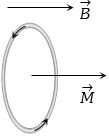
A current carrying loop is free to turn in a uniform magnetic field. The loop will then come into equilibrium when its plane is inclined at
A$0^\circ $ to the direction of the field
B$45^\circ $ to the direction of the field
C$90^\circ $ to the direction of the field
D$135^\circ $ to the direction of the field
Easy
Download our app for free and get started
C$90^\circ $ to the direction of the field
c In equilibrium angle between $\overrightarrow M $and $\overrightarrow B $ is zero. It is happened, when plane of the coil is perpendicular to $\overrightarrow B $
Download our app
and get started for free
Experience the future of education. Simply download our apps or reach out to us for more information. Let's shape the future of learning together!No signup needed.*
A galvanometer of resistance $40\,\Omega $ gives a deflection of $5\, divisions$ per $mA$. There are $50\, divisions$ on the scale. The maximum current that can pass through it when a shunt resistance of $2\,\Omega $ is connected is ................ $mA$
Two identical coils of radius $R$ and number of turns $N$ are placed perpendicular to each others in such a way that they have common centre. The current through them are $I$ and $I\sqrt 3$ . The resultant intensity of magnetic field at the centre of the coil will be (in $weber/m^2)2$
A long circular tube of length $10 \ m$ and radius $0.3 \ m$ carries a current $I$ along its curved surface as shown. A wire-loop of resistance $0.005$ ohm and of radius $0.1 \ m$ is placed inside the tube with its axis coinciding with the axis of the tube. The current varies as $I=I_0 \cos (300 t)$ where $I_0$ is constant. If the magnetic moment of the loop is $N \mu_0 I_0 \sin (300 t)$, then ' $N$ ' is
The radius of a circular ring of wire is $R$ and it carries a current of $I\,ampere$. At its centre a smaller ring of radius $r$ with current $i$ and $N\, turns$ is placed. Assuming that the planes of two rings are perpendicular to each other and the magnetic induction produced at the centre of bigger ring is constant, then the torque acting on smaller ring will be
A magnet of magnetic moment $50\,\hat i\,A{\rm{ - }}{m^2}$ is placed along the $x-$ axis in a magnetic field $\overrightarrow B = (0.5\,\hat i + 3.0\hat j)\,T.$ The torque acting on the magnet is
Two parallel wires in the plane of the paper are distance $X _0$ apart. A point charge is moving with speed $u$ between the wires in the same plane at a distance $X_1$ from one of the wires. When the wires carry current of magnitude $I$ in the same direction, the radius of curvature of the path of the point charge is $R_1$. In contrast, if the currents $I$ in the two wires have direction opposite to each other, the radius of curvature of the path is $R_2$.
If $\frac{x_0}{x_1}=3$, the value of $\frac{R_1}{R_2}$ is.
A circular loop is kept in that vertical plane which contains the north-south direction. It carries a current that is towards south at the topmost point. Let $A$ be a point on axis of the circle to the east of it and $B$ a point on this axis to the west of it. The magnetic field due to the loop :-
The resistance of a galvanometer is $25\, ohm$ and it requires $50\,\mu A$ for full deflection. The value of the shunt resistance required to convert it into an ammeter of $5\, amp$ is