A galvanometer of resistance $40\,\Omega $ gives a deflection of $5\, divisions$ per $mA$. There are $50\, divisions$ on the scale. The maximum current that can pass through it when a shunt resistance of $2\,\Omega $ is connected is ................ $mA$
Medium
Download our app for free and get started
$I_{G}=\frac{50}{5}=10 \mathrm{\,mA} ; \mathrm{R}_{\mathrm{G}}=40\, \Omega, \mathrm{R}_{\mathrm{s}}=2\, \Omega$
Maximum current,
$\mathrm{I}=\frac{\mathrm{R}_{\mathrm{G}}+\mathrm{R}_{\mathrm{S}}}{\mathrm{R}_{\mathrm{G}}} \times \mathrm{I}_{\mathrm{G}}=\frac{(40+2) \times 10}{2}=210 \mathrm{\,mA}$

Download our appand get started for free
Experience the future of education. Simply download our apps or reach out to us for more information. Let's shape the future of learning together!No signup needed.*
Similar Questions
- 1A proton is moving along $Z$-axis in a magnetic field. The magnetic field is along $X$-axis. The proton will experience a force alongView Solution
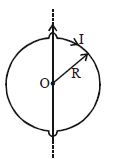
- 2A circular conducting loop of radius $R$ carries a current $I.$ Another straight infinite conductor carrying current $I$ passes through the diameter of this loop as shown in the figure. The magnitude of force exerted by the straight conductor on the loop isView Solution
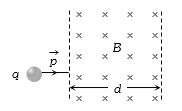
- 3A particle with charge $q$, moving with a momentum $p$, enters a uniform magnetic field normally. The magnetic field has magnitude $B$ and is confined to a region of width $d$, where $d < \frac{p}{{Bq}}$, The particle is deflected by an angle $\theta $ in crossing the fieldView Solution
- 4The expression for magnetic induction inside a solenoid of length $L$ carrying a current $I$ and having $N$ number of turns isView Solution
- 5A galvanometer of resistance $50\, \Omega$ is connected to a battery of $3\, V$ along with a resistance of $2950\, \Omega$ in series. A full scale deflection of $30$ divisions is obtained in the galvanometer. In order to reduce this deflection to $20$ divisions, the resistance in series should be.......$Ω$View Solution
- 6The magnetic field is uniform for $y>0$ and points into the plane. The magnetic field is uniform and points out of the plane for $y<0$. A proton denoted by filled circle leaves $y=0$ in the $-y$-direction with some speed as shown below.Which of the following best denotes the trajectory of the proton?View Solution

- 7A circular coil of radius $4\, cm$ has $50$ $turns$. In this coil a current of $2\, A$ is flowing. It is placed in a magnetic field of $0.1$ $weber/{m^2}$. The amount of work done in rotating it through $180^\circ $ from its equilibrium position will be........$J$View Solution
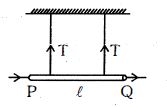
- 8A conducting bar $PQ$ of length $l$ carrying current $I$ is suspended from a rigid support as shown in figure. A uniform magnetic field $B$ perpendicular to $PQ$ and directed away from the reader (inside the plane) is applied. If the mass of the bar is $M$ the tension in each string isView Solution
- 9View SolutionA proton and an alpha particle of the same enter in a uniform magnetic field which is acting perpendicular to their direction of motion. The ratio of the circular paths described by the alpha particle and proton is ....
- 10The region between $y = 0$ and $y = d$ contains a magnetic field $\vec B = B\hat z$ A particle of mass $m$ and charge $q$ enters the region with a velocity $\vec v = v\hat i$. If $d = \frac{{mv}}{{2qB}}$ , the acceleration of the charged particle at the point of its emergence at the other side isView Solution