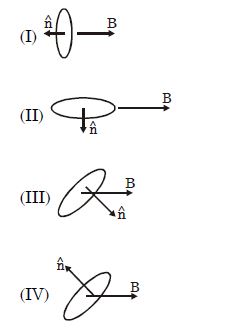
A current carrying loop is placed in a uniform magnetic field in four different orientations; $I,\, II,\, III$ and $IV,$ arrange them in the decreasing order of potential energy
A$I > III > II > IV$
B$I > II > III > IV$
C$I > IV > II > III$
D$III > IV > I > II$
Medium
Download our app for free and get started
C$I > IV > II > III$
c $U = \, - \vec M.\vec B = - MB\cos \theta $
Download our app
and get started for free
Experience the future of education. Simply download our apps or reach out to us for more information. Let's shape the future of learning together!No signup needed.*
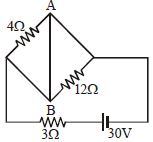
A teacher in his physics laboratory allotted an experiment to determine the resistance $(G)$ of a galvanometer. Students took the observations for $\frac{1}{3}$ deflection in the galvanometer. Which of the below is true for measuring value of $G$ $?$
When a current of $5\ mA$ is passed through a galvanometer having a coil of resistance $15\ \Omega$, it shows full scale deflection. The value of the resistance to be put in series with the galvanometer to convert it into to voltmeter of range $0 - 10\ V$ is
Two moving coil meters $M_1$ and $M_2$ having the following particulars :-
$R_1 = 10\,\Omega , N_1 = 30, A_1 = 3.6\times10^{-3}\, m^2, B_1 = 0.25\, T$
$R_2 = 14\,\Omega , N_2 = 42, A_2 = 1.8\times10^{-3}\, m^2, B_2 = 0.50\, T$
(The spring constants are identical for the two meters). Determine the ratio of voltage sensitivity of $M_2$ and $M_1$
A rigid square loop of side $a$ and carrying current $I_2$ is laying on a horizontal surface near a long current $I_1$ wire in the same plane as shown in figure. The net force on the loop due to the wire will be
A proton is accelerating in a cyclotron where the applied magnetic field is $2 \,T$. If the potential gap is effectively $100 \,kV$ then how much revolutions the proton has to make between the "dees" to acquire a kinetic energy of $20 \,MeV$ ?
Two ions having masses in the ratio $1 : 1$ and charges $1 : 2$ are projected into uniform magnetic field perpendicular to the field with speeds in the ratio $2 : 3$. The ratio of the radii of circular paths along which the two particles move is
An electric field of $1500\, V/m$ and a magnetic field of $0.40\, weber/metre^2$ act on a moving electron. The minimum uniform speed along a straight line the electron could have is
A current of $I$ $ampere$ is passed through a straight wire of length $2.0$ $metres$. The magnetic field at a point in air at a distance of $3$ $metres$ from either end of wire and lying on the axis of wire will be
An infinitely long straight conductor $AB$ is fixed and a current is passed through it. Another movable straight wire $CD$ of finite length and carrying current is held perpendicular to it and released. Neglect weight of the wire
A square loop of side $2\, a ,$ and carrying current I, is kept in $XZ$ plane with its centre at origin. A long wire carrying the same current $I$ is placed parallel to the $z-$axis and passing through the point $(0, b, 0),(b>>a)$. The magnitude of the torque on the loop about $z-$axis is given by: