An electric field of $1500\, V/m$ and a magnetic field of $0.40\, weber/metre^2$ act on a moving electron. The minimum uniform speed along a straight line the electron could have is
Medium


Download our appand get started for free
Experience the future of education. Simply download our apps or reach out to us for more information. Let's shape the future of learning together!No signup needed.*
Similar Questions
- 1If induction of magnetic field at a point is $B$ and energy density is $U$ then which of the following graphs is correctView Solution
- 2If $n$ represents the actual number of deflections in a converted galvanometer of resistance $G$ and shunt resistance $S$. Then the total current I when its figure of merit is $K$ will beView Solution
- 3A proton and an alpha particle are separately projected in a region where a uniform magnetic field exists. Their initial velocities are perpendicular to direction of magnetic field. If both the particles move around magnetic field in circles of equal radii, the ratio of momentum of proton to alpha particle $\left( {\frac{{{P_p}}}{{{P_\alpha }}}} \right)$ isView Solution
- 4View SolutionWhich of the following particle will experience maximum acceleration when projected with same speed in transverse magnetic field
- 5A galvanometer gives full scale reading of $50\ mA$ , when a $p.d.$ , across its terminals is $0.15\ V$ . It can be used as an ammeter of range $0 - 100\ A$ by connecting a shunt resistance ofView Solution
- 6A current $i$ $ampere$ flows along an infinitely long straight thin walled tube, then the magnetic induction at any point inside the tube isView Solution
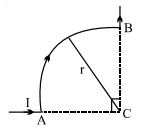
- 7A wire carrying $I$ is shaped as shown. Section $AB$ is a quarter circle of radius $r.$ The magnetic field at $C$ is directedView Solution
- 8A particle of charge $q$ and mass $m$ moves in a circular orbit of radius $r$ with angular speed $\omega $. The ratio of the magnitude of its magnetic moment to that of its angular momentum depends onView Solution
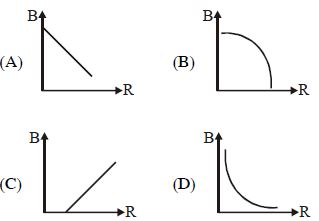
- 9Which of the following graphs correctly represents the variation of magnetic field with distance $R$ from a long straight current carrying conductor ?View Solution
- 10When a proton is released from rest in a room, it starts with an initial acceleration $a_0$ towards west. When it is projected towards north with a speed $v_0$ it moves with an initial acceleration $3a_0$ toward west. The electric and magnetic fields in the room areView Solution