Question
A current carrying loop is placed in a uniform magnetic field. The torque acting on it does not depend upon:
Answer

  1. Shape of the loop.

Need a full question paper?

Generate a complete, print-ready paper with questions like this in minutes — across 16+ boards, with answer keys.

Start Generating Free

Similar questions

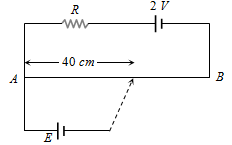
$AB$ is a potentiometer wire of length $100 \ cm$ and its resistance is $10$ ohms. It is connected in series with a resistance $R = 40$ ohms and a battery of $\text{e.m.f.}\ 2 V$ and negligible internal resistance. If a source of unknown $\text{e.m.f.} \ E$ is balanced by $40 \ cm$ length of the potentiometer wire, the value of $E$ is
A capacitor $C_1$ of capacitance $1\ \mu\text{F}$ and a capacitor $C_2$ of capacitance $2\ \mu\text{F}$ are separately charged by a common battery for a long time. The two capacitors are then separately discharged through equal resistors. Both the discharge circuits are connected at $t = 0.$
In electrolytic capacitors positive terminal is
The correct curve representing the variation of capacitive reactance $Xc$​ with frequency $f$ is.
In human eye the focussing is done by(a) To and fro movement of eye lens (b) To and fro movement of the retina  (c) Change in the convexity of the lens surface (d) Change in the refractive index of the eye fluids


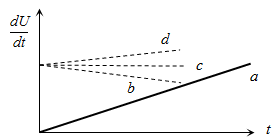
A constant current i is passed through a resistor.  Taking the temperature coefficient of resistance into account, indicate which of the plots shown in figure best represents the rate of production of thermal energy in the resistor
The apparent wavelength of the light from a star moving away from the earth is 0.01% more than its real wavelength. Then the velocity of star is(a) 60 km/sec(b) 15 km/sec(c) 150 km/sec(d) 30 km/sec
       
Let $\overrightarrow{\text{A}}$ be a unit vector along the axis of rotation of a purely rotating body and $\overrightarrow{\text{B}}$ be a unit vector along the velocity of a particle P of the body away from the axis. The value of $\overrightarrow{\text{A}}.\overrightarrow{\text{B}}$ is:
  1. 1
  2. -1
  3. 0
  4. None of these.
A capacitor acts as an infinite resistance for.
The inverse square law of intensity $\Big(\text{i.e., the intensity}\propto\frac{1}{\text{r}^2}\Big)$ is valid for a: