A particle with ${10^{ - 11}}\,coulomb$ of charge and ${10^{ - 7}}\,kg$ mass is moving with a velocity of ${10^8}\,m/s$ along the $y$-axis. A uniform static magnetic field $B = 0.5\,Tesla$ is acting along the $x$-direction. The force on the particle is
Medium
Download our app for free and get started
(d) $\overrightarrow F = q\,(\overrightarrow {v\,} \times \overrightarrow B ) = {10^{ - 11}}({10^8}\hat j\, \times 0.5\hat i)$
$ = 5 \times {10^{ - 4}}(\hat j \times \hat i) = 5 \times {10^{ - 4}}N( - \hat k)$
$ = 5 \times {10^{ - 4}}(\hat j \times \hat i) = 5 \times {10^{ - 4}}N( - \hat k)$

Download our appand get started for free
Experience the future of education. Simply download our apps or reach out to us for more information. Let's shape the future of learning together!No signup needed.*
Similar Questions
- 1A galvanometer of resistance $40\,\Omega $ gives a deflection of $5\, divisions$ per $mA$. There are $50\, divisions$ on the scale. The maximum current that can pass through it when a shunt resistance of $2\,\Omega $ is connected is ................ $mA$View Solution
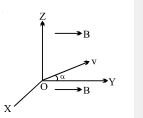
- 2In a region of space, a uniform magnetic field $B$ exists in the $y-$direction.Aproton is fired from the origin, with its initial velocity $v$ making a small angle $\alpha$ with the $y-$ direction in the $yz$ plane. In the subsequent motion of the proton,View Solution
- 3Magnetic field due to $0.1\, A$ current flowing through a circular coil of radius $0.1\, m$ and $1000$ $turns$ at the centre of the coil isView Solution
- 4View SolutionThe resultant magnetic moment of neon atom will be
- 5View SolutionIf cathode rays are projected at right angles to a magnetic field, their trajectory is
- 6An electron is moving along $+x$ direction with a velocity of $6 \times 10^{6}\, ms ^{-1}$. It enters a region of uniform electric field of $300 \,V / cm$ pointing along $+ y$ direction. The magnitude and direction of the magnetic field set up in this region such that the electron keeps moving along the $x$ direction will beView Solution
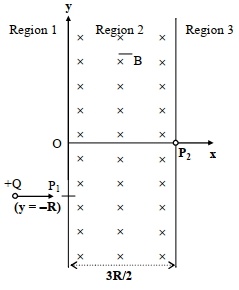
- 7A uniform magnetic field $B$ exists in the region between $x=0$ and $x=\frac{3 R}{2}$ (region $2$ in the figure) pointing normally into the plane of the paper. A particle with charge $+Q$ and momentum $p$ directed along $x$-axis enters region $2$ from region $1$ at point $P_1(y=-R)$. Which of the following option(s) is/are correct?View Solution
$[A$ For $B>\frac{2}{3} \frac{p}{QR}$, the particle will re-enter region $1$
$[B]$ For $B=\frac{8}{13} \frac{\mathrm{p}}{QR}$, the particle will enter region $3$ through the point $P_2$ on $\mathrm{x}$-axis
$[C]$ When the particle re-enters region 1 through the longest possible path in region $2$ , the magnitude of the change in its linear momentum between point $P_1$ and the farthest point from $y$-axis is $p / \sqrt{2}$
$[D]$ For a fixed $B$, particles of same charge $Q$ and same velocity $v$, the distance between the point $P_1$ and the point of re-entry into region $1$ is inversely proportional to the mass of the particle
- 8View SolutionThe time period of a charged particle undergoing a circular motion in a uniform magnetic field is independent of its
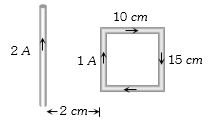
- 9View SolutionWhat is the net force on the square coil
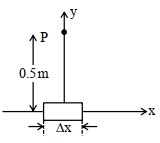
- 10An element $\Delta l=\Delta \mathrm{xi}$ is placed at the origin and carries a large current $\mathrm{I}=10 \mathrm{~A}$. The magnetic field on the $y$-axis at a distance of $0.5 \mathrm{~m}$ from the elements $\Delta \mathrm{x}$ of $1 \mathrm{~cm}$ length is:View Solution