A current i passes through a wire of length $l$, radius of cross-section $r$ and resistivity $\rho$. The rate of heat generation is
Easy


Download our appand get started for free
Experience the future of education. Simply download our apps or reach out to us for more information. Let's shape the future of learning together!No signup needed.*
Similar Questions
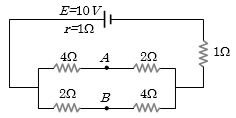
- 1In the circuit shown below, the cell has an $e.m.f.$ of $10\,V$ and internal resistance of $1\, ohm$. The other resistances are shown in the figure. The potential difference ${V_A} - {V_B}$ is ................ $V$View Solution
- 2The resistances of a wire at temperatures $t\,^oC$ and $0\,^oC$ are related byView Solution
- 3A wire of length $100\, cm$ is connected to a cell of emf $2\,V$ and negligible internal resistance. The resistance of the wire is $3\,\Omega $. The additional resistance required to produce a potential difference of $1\, mV/cm$ is ............. $\Omega$View Solution
- 4When a current of $2\, A$ flows in a battery from negative to positive terminal, the potential difference across it is $12\, V$. If a current of $3 \,A$ flows in the opposite direction potential difference across the terminals of the battery is $15\, V$, the $emf$ of the battery is ................ $\mathrm{V}$View Solution
- 5In an electric circuit, a cell of certain emf provides a potential difference of $1.25\, {V}$ across a load resistance of $5\, \Omega .$ However, it provides a potential difference of $1\, {V}$ across a load resistance of $2\, \Omega$. The $emf$ of the cell is given by $\frac{x}{10} v$. Then the value of $x$ is ..... .View Solution
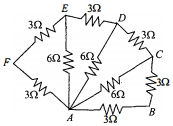
- 6Six resistors of $3 \;\Omega$ each are connected along the sides of a hexagon and three resistors of $6\; \Omega$ each are connected along $A C, A D$ and $A E$ as shown in the figure. The equivalent resistance between $A$ and $B$ is equal toView Solution
- 7The potential difference in open circuit for a cell is $2.2\, volts$. When a $4\, ohm$ resistor is connected between its two electrodes the potential difference becomes $2\, volts$. The internal resistance of the cell will be .............. $ohm$View Solution
- 8Two resistance of $100\ \Omega$ and $200\ \Omega$ are connected in series with a battery of $4 \mathrm{~V}$ and negligible internal resistance. $A$ voltmeter is used to measure voltage across $100 \Omega$ resistance, which gives reading as $1 \mathrm{~V}$. The resistance of voltmeter must be ___$\Omega$.View Solution
- 9An electric kettle has two heating coils. When one coil is used, water in the kettle boils in $5$ minutes, while when second coil is used, same water boils in $10\,\min$. If the two coils, connected in parallel are used simultaneously, the same water will boil in timeView Solution
- 10Kirchhoff's first law $i.e.$ $\Sigma i = 0$ at a junction is based on the law of conservation ofView Solution