Kirchhoff's first law $i.e.$ $\Sigma i = 0$ at a junction is based on the law of conservation of
AIIMS 2000,AIPMT 1997,AIPMT 1992, Easy


Download our appand get started for free
Experience the future of education. Simply download our apps or reach out to us for more information. Let's shape the future of learning together!No signup needed.*
Similar Questions
- 1The terminal potential difference of a cell is greater than its $e.m.f.$ when it isView Solution
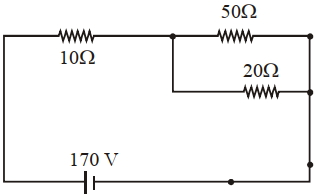
- 2The voltage across the $10\, \Omega$ resistor in the given circuit is $x$ volt.View Solution
The value of $'x'$ to the nearest integer is..........
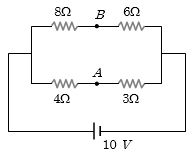
- 3The potential difference between point $A$ and $B$ is ............. $V$View Solution
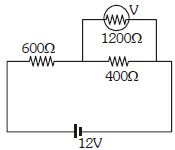
- 4Find the error in reading of voltmeter ................ $\%$View Solution
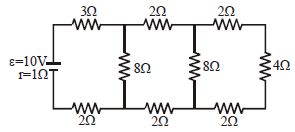
- 5In the circuit shown, the cell has $emf = 10\,V$ and internal resistance $= 1\, \Omega$ :-View Solution
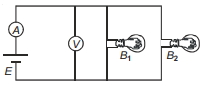
- 6Two identical bulbs are connected in parallel across an ideal source of emf $E$. The ammeter $A$ and voltmeter $V$ are ideal. If bulb $B_2$ gets fused, thenView Solution
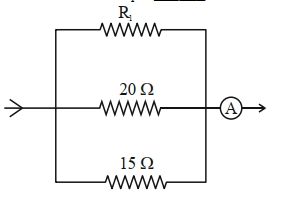
- 7In the given circuit, the current flowing through the resistance $20\ \Omega$ is $0.3 \mathrm{~A}$, while the ammeter reads $0.9 \mathrm{~A}$. The value of $\mathrm{R}_1$ is_____________ $\Omega$.View Solution
- 8A galvanometer together with an unknown resistance in series is connected to two identical batteries each of $1.5\, V$. When the batteries are connected in series, the galvanometer records a current of $1\,A$, and when batteries are in parallel the current is $0.6\,A$. What is the internal resistance of the battery ?View Solution
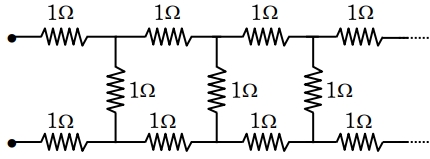
- 9View SolutionThe equivalent resistance of the infinite network given below is :
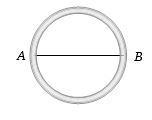
- 10The resistance of a wire is ${10^{ - 6}}\,\Omega $ per meter. It is bend in the form of a circle of diameter $2\,m$. A wire of the same material is connected across its diameter. The total resistance across its diameter $AB$ will beView Solution