A current of $10\, ampere$ is flowing in a wire of length $1.5\, m$. A force of $15\, N$ acts on it when it is placed in a uniform magnetic field of $2$ $tesla$. The angle between the magnetic field and the direction of the current is.....$^o$
Easy


Download our appand get started for free
Experience the future of education. Simply download our apps or reach out to us for more information. Let's shape the future of learning together!No signup needed.*
Similar Questions
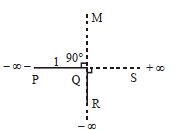
- 1An infinitely long conductor $PQR$ is bent to from a right angle as shown. A current $I$ flows through $PQR$ . The magnetic field due to this current at the point $M$ is $H_1$ . Now, another infinitely long straight conductor $QS$ is connected at $Q$ so that the current in $PQ$ remaining unchanged. The magnetic field at $M$ is now $H_2$ . The ratio $H_1/H_2$ is given byView Solution
- 2If $ m$ is magnetic moment and $B$ is the magnetic field, then the torque is given byView Solution
- 3In a mass spectrometer used for measuring the masses of ions, the ions are initially accelerated by an electric potential $V$ and then made to describe semicircular paths of radius $R$ using a magnetic field $B$. If $V$ and $B$ are kept constant, the ratio $\left( {\frac{{{\text{charge on the ion}}}}{{{\text{mass of the ion}}}}} \right)$ will be proportional toView Solution
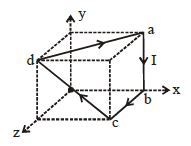
- 4In figure the cube is of $40\,\, cm$ edge. Four straight segment of wire $ab, bc, cd$ and $da$ form a closed loop that carries a current $I = 5\,A$. A uniform magnetic field $0.02\,\,T$ is in $+y\,-$ direction ratio of magnetic force on segement $ab$ and $bc$ isView Solution
- 5View SolutionA beam of electrons passes undeflected through mutually perpendicular electric and magnetic fields. It the electric field is switched off, and the same magnetic field is maintained, the electrons move
- 6An electron and a proton are moving on straight parallel paths with same velocity. They enter a semi-infinite region of uniform magnetic field perpendicular to the velocity. Which of the following statement$(s)$ is/are true?View Solution
$(A)$ They will never come out of the magnetic field region.
$(B)$ They will come out travelling along parallel paths.
$(C)$ They will come out at the same time.
$(D)$ They will come out at different times.
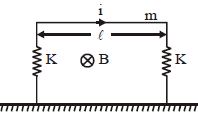
- 7A horizontal metallic rod of mass $'m'$ and length $'l'$ is supported by two vertical identical springs of spring of spring constant $'K'$ each and natural length $l_0.$ A current $'i'$ is flowing in the rod in the direction shown. If the rod is in equilibrium then the length of each spring in this state is :-View Solution
- 8charged particle with charge $q$ enters a region of constant, uniform and mutually orthogonal fields $\vec E$ and $\vec B$ with a velocity $\vec v$ perpendicular to both $\vec E$ and $\vec B$ , and comes out without any change in magnitude or direction of $\vec v$ . ThenView Solution
- 9$20$ $ampere$ current is flowing in a long straight wire. The intensity of magnetic field at a distance $20\, cm$ from the wire will beView Solution
- 10View SolutionTesla is the unit of