Question
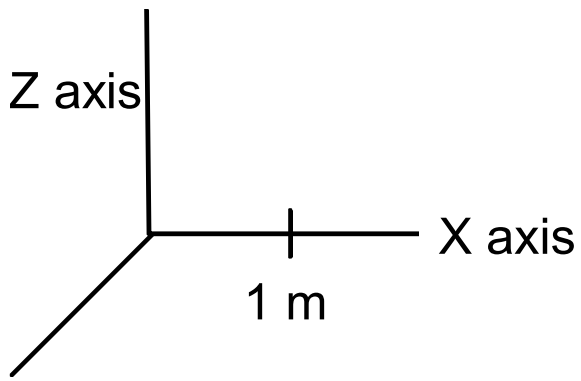
A current of 10A is established in a long wire along the positive z-axis. Find the magnetic field $\overrightarrow{\text{B}}$ at the point (1m, 0, 0).
Answer

$\text{i} = 10\text{A},\text{d} = 1\text{m}$
$\text{B}=\frac{\mu_0\text{i}}{2\pi\text{r}}=\frac{10^{-7}\times4\pi\times10}{2\pi\times1}$
$=20\times10^{-6}\text{T}=2\mu\text{T}$
Along +ve Y direction.

Need a full question paper?

Generate a complete, print-ready paper with questions like this in minutes — across 16+ boards, with answer keys.

Start Generating Free

Similar questions

Two heavy spheres each of mass 100 kg and radius 0.10 m are placed 1.0 m apart on a horizontal table. What is the gravitational force and potential at the midpoint of the line joining the centres of the spheres? Is an object placed at that point in equilibrium? If so, is the equilibrium stable or unstable?
What is the technique used for measuring large time intervals?
A body goes from A to B with a velocity of 40m/s and comes back from B to A with a velocity of 60m/s. What is the (i) average velocity during the whole journey and (ii) average speed during the whole journey?
A brass plate having surface area $200cm^2$ on one side is electroplated with $0·10mm$ thick silver layers on both sides using a $15A$ current. Find the time taken to do the job. The specific gravity of silver is $10.5$ and its atomic weight is $107.9 g/mol$.
Can a body in translatory motion have angular momentum? Explain.
When you stand on the sand, your feet sink deeper into it, but when you lie down, your body sinks less into the sand, why?
Calculate the energy required to move a body of mass $m$ from an orbit of radius $2 R$ to $3 R$.
Ten identical discs each weighing 1 kg are placed one above the other on a horizontal page. Find out :
(i) Reaction force on the first disc from the top.
(ii) Reaction on force on the seventh disc from the top, $g=9.8 m / s ^2$.
(iii) Show all the forces acting on the tenth disc from the top.
A transverse harmonic wave on a string is described by
$\text{y}(\text{x, t})=3.0\sin\big(36\text{t}+0.018\text{x}+\frac{\pi}{4}\big)$
where x and y are in cm and t in s. The positive direction of x is from left to right.
What are its amplitude and frequency?
In Exercise, let us take the position of mass when the spring is unstreched as x = 0, and the direction from left to right as the positive direction of x-axis. Give x as a function of time t for the oscillating mass if at the moment we start the stopwatch (t = 0), the mass is:At the maximum stretched position.
In what way do these functions for SHM differ from each other, in frequency, in amplitude or the initial phase?