Question
When you stand on the sand, your feet sink deeper into it, but when you lie down, your body sinks less into the sand, why?

Answer

In standing position the area is less but when you lie down the area is more. Whereas in both the cases the weight force is the same. Therefore, in the lying position the body sinks less due to less pressure $P = F/A$ as compared to the standing positon.

Need a full question paper?

Generate a complete, print-ready paper with questions like this in minutes — across 16+ boards, with answer keys.
Start Generating Free

Similar questions

A diatomic gas is heated in a vessel to a temperature of 10000K. If each molecule possess an average energy $E_1$. After sometime, a few molecule escape into the atmosphere at 300 K. Due to which, their energy changes to $E_2​​​​​​​$. Calculate the ratio of $\frac{\text{E}_1}{\text{E}_2}.$
A block of mass 5.0kg slides down an incline of inclination 30° and length 10m. Find the work done by the force of gravity.
Earth's radius is about $6370\ km.$ A mass of $20\ kg$ is taken to a height of $160\ km$ above the earth's surface.
  1. What is the mass of the objects at that height?
  2. How much does the object weigh at this height?
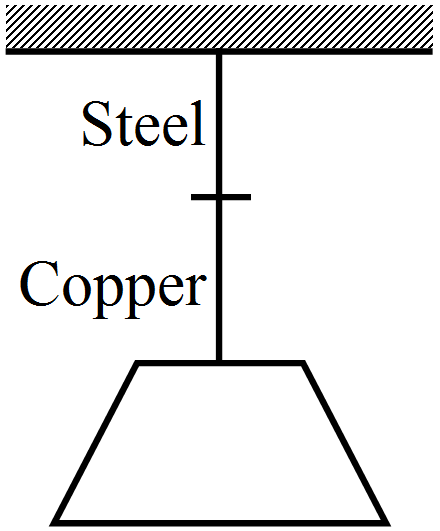
In the upper wire is made of steel and the lower of copper. The wires have equal cross-section. Find the ratio of the longitudinal strains developed in the two wires.
Two masses M and m are connected at the two ends of an inextensible, light string. The string passes over a smooth frictionless pulley. Calculate the acceleration of the masses and the tension in the string. M is heavier than m.
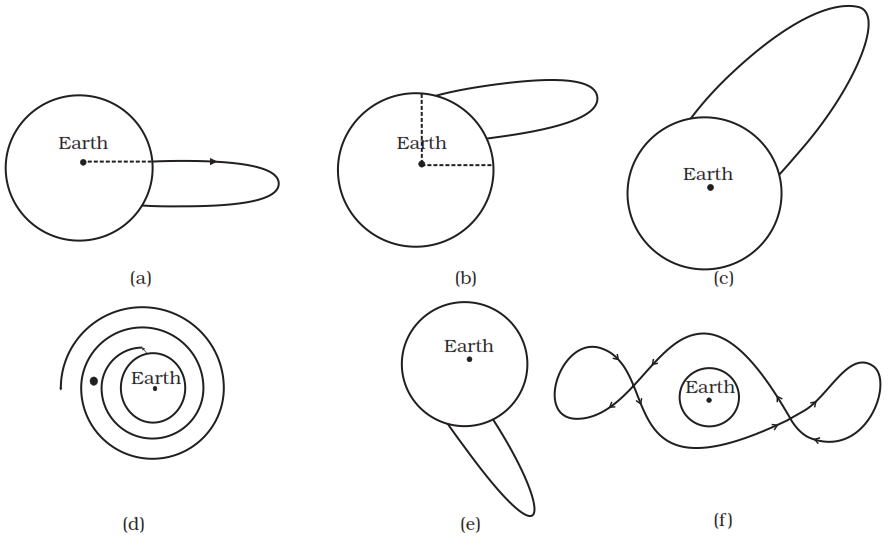
Shown are several curves. Explain with reason, which ones amongst them can be possible trajectories traced by a projectile (neglect air friction).
A particle moves on a given straight line with a constant speed v. At a certain time it is at a point P on its straight line path. O is a fixed point. Show that $\overrightarrow{\text{OP}}\times\overrightarrow{\text{v}}$ is independent of the position P.
Two identical blocks of mass 2 kg move towards each other with a uniform speed ( $2 m / s$ ) on a frictionless horizontal plane. They collide with each other and get attached to each other and comes to a state of rest. Calculate the work done by external forces and internal forces on the system of both the particles.
Let I = current through a conductor, R = its resistance and V = potential difference across its ends. According to Ohm's law, product of two of these quantities equals the third. Obtain Ohm's law from dimensional analysis. Dimensional formulae for R and V are $\text{ML}^2\text{I}^{-2}\text{T}^{-3}$ and $\text{ML}^2\text{T}^{-3}\text{I}^{-1}$ respectively.
Explain why: Air pressure in a car tyre increases during driving.