A current of $2\, A$ passing through conductor produces $80\, J$ of heat in $10$ seconds. The resistance of the conductor is ............ $\Omega$
AIPMT 1989, Easy
Download our app for free and get started
$H = {i^2}Rt$ $ \Rightarrow $ $R = \frac{H}{{{i^2}t}} = \frac{{80}}{{4 \times 10}} = 2\,\,\Omega $

Download our appand get started for free
Experience the future of education. Simply download our apps or reach out to us for more information. Let's shape the future of learning together!No signup needed.*
Similar Questions
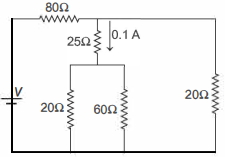
- 1A current of $0.1 \,A$ flows through a $25 \,\Omega$ resistor represented by the circuit diagram. The current in $80 \,\Omega$ resistor is ........... $A$View Solution
- 2A $16\, \Omega$ wire is bend to form a square loop. A $9 \,{V}$ supply having internal resistance of $1 \,\Omega$ is connected across one of its sides. The potential drop across the diagonals of the square loop is $.......\,\times 10^{-1} \,{V}$View Solution
- 3The heating coils rating at $220\, volt$ and producing $50\, cal/sec$ heat are available with the resistances $55\,\Omega $ , $110\,\Omega$ , $220\,\Omega $ and $440\,\Omega $. The heater of maximum power will be of............. $\Omega$View Solution
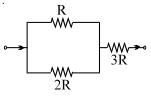
- 4The ratio of powers dissipatted respectively in $R$ and $3R$, as shown is:View Solution
- 5Two coils require $20$ minutes and $60$ minutes respectively to produce same amount of heat energy when connected separately to the same source. If they are connected in parallel arrangement to the same source; the time required to produce same amount of heat by the combination of coils, will be________ $min$View Solution
- 6A student has $10$ resistors of resistance ‘$r$’. The minimum resistance made by him from given resistors isView Solution
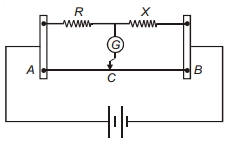
- 7In the meter bridge shown, the resistance $X$ has a negative temperature coefficient of resistance. Neglecting the variation in other resistors, when current is passed for some time, in the cirucit, balance point should shift towards.View Solution
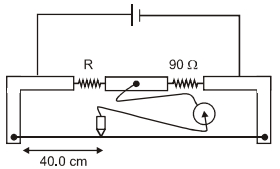
- 8During an experiment with a metre bridge, the galvanometer shows a null point when the joceky is pressed at $40.0 \ cm$ using a standard resistance of $90 \ \Omega$, as shown in the figure. The least count of the scale used in the meter bridge is $1 \ mm$. The unknown resistance is:View Solution
- 9In a potentiometer experiment the balancing with a cell is at length $240\, cm$. On shunting the cell with a resistance of $2$ $\Omega$, the balancing length becomes $120\, cm$. The internal resistance of the cell is ................. $\Omega $View Solution
- 10If an electric heater is rated at $1000\, W$, then the time required to heat one litre of water from $20\,^oC$ to $60\,^oC$ isView Solution