Two equal resistances when connected in series to a battery, consume electric power of $60\,W.$ If these resistances are now connected in parallel combination to the same battery, the electric power consumed will be .............. $W$
JEE MAIN 2019, Medium


Download our appand get started for free
Experience the future of education. Simply download our apps or reach out to us for more information. Let's shape the future of learning together!No signup needed.*
Similar Questions
- 1A potentiometer wire of length $L$ and a resistance $r$ are connected in series with a battery of e.m.f. $E_0$ and a resistance $r_1$. An unknown e.m.f. $E$ is balanced at a length $l$ of the potentiometer wire. The e.m.f. $E$ will be given byView Solution
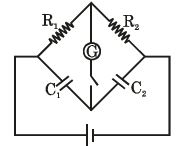
- 2View SolutionCircuit shown is in steady state, now when switch is closed, galvanometer shows no deflection, then correct relation is
- 3The resistance of a bulb filmanet is $100\,\Omega$ at a temperature of $100\,^o C$. If its temperature coefficient of resistance be $0.005$ per $^o C$, its resistance will become $200\,\Omega$ at a temperature of ................ $^oC$View Solution
- 4View SolutionA piece of wire is cut into four equal parts and the pieces are bundled together side by side to form a thicker wire. Compared with that of the original wire, the resistance of the bundle is ..........
- 5View SolutionThere are three resistance coils of equal resistance. The maximum number of resistances you can obtain by connecting them in any manner you choose, being free to use any number of the coils in any way is
- 6The resistance of platinum wire at $0^{\circ}\,C$ is $2\,\Omega$ and $6.8\,\Omega$ at $80^{\circ} \,C$. The temperature coefficient of resistance of the wire is :View Solution
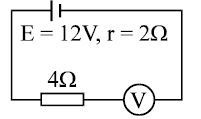
- 7By error, a student places moving-coil voltmeter $V$ (nearly ideal) in series with the resistance in a circuit in order to read the current, as shown. The voltmeter reading will be ............ $V$View Solution
- 8In an experiment to find $emf$ of a cell using potentiometer, the length of null point for a cell of emf $1.5\,V$ is found to be $60\,cm$. If this cell is replaced by another cell of $emf\; E$. the length-of null point increases by $40\,cm$. The value of $E$ is $\frac{x}{10} V$. The value of $x$ is $............$View Solution
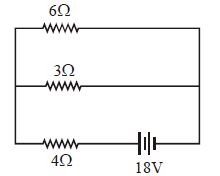
- 9The total power dissipated in watts in the circuit shown is ............. $W$View Solution
- 10Current density in a cylindrical wire of radius $R$ is given as $J =$ $\left\{ {\begin{array}{*{20}{c}}View Solution
{{J_0}\left( {\frac{x}{R} - 1} \right)\,\,for\,\,0 \leqslant x < \frac{R}{2}} \\
{{J_0}\frac{x}{R}\,\,\,\,for\,\,\,\frac{R}{2} \leqslant x \leqslant R}
\end{array}} \right.$The current flowing in the wire is: