A current of $2\,A$ flows through a wire of crosssectional area $25.0\,mm ^2$. The number of free electrons in a cubic meter are $2.0 \times 10^{28}$. The drift velocity of the electrons is $...............\times 10^{-6}\,ms ^{-1}$ (given, charge on electron $=1.6 \times 10^{-19}\,C$ )
JEE MAIN 2023, Easy


Download our appand get started for free
Experience the future of education. Simply download our apps or reach out to us for more information. Let's shape the future of learning together!No signup needed.*
Similar Questions
- 1The resistance of platinum wire at $0^{\circ}\,C$ is $2\,\Omega$ and $6.8\,\Omega$ at $80^{\circ} \,C$. The temperature coefficient of resistance of the wire is :View Solution
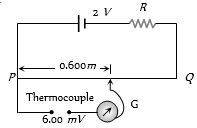
- 2Figure shows a simple potentiometer circuit for measuring a small $e.m.f$. produced by a thermocouple. The meter wire $PQ$ has a resistance $5 \,\Omega$ and the driver cell has an e.m.f. of $2\, V$. If a balance point is obtained $0.600\, m$ along $PQ$ when measuring an e.m.f. of $6.00\, mV$, what is the value of resistance $R$ ............... $\Omega$View Solution
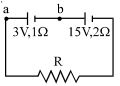
- 3Two batteries one of the $\mathrm{emf}$ $3\,V$, internal resistance $1$ ohm and the other of $\mathrm{emf}$ $15\, V$, internal resistance $2$ $\mathrm{ohm}$ are connected in series with a resistance $R$ as shown. If the potential difference between $a$ and $b$ is zero the resistance of $R$ in $\mathrm{ohm}$ isView Solution
- 4A piece of fuse wire melts when a current of $15\, ampere$ flows through it. With this current, if it dissipates $22.5\, W$, the resistance of fuse wire will be .............. $\Omega$View Solution
- 5A null point is found at $200\,cm$ in potentiometer when cell in secondary circuit is shunted by $5\,\Omega$. When a resistance of $15\,\Omega$ is used for shunting null point moves to $300\,cm$. The internal resistance of the cell is $..............\,\Omega$.View Solution
- 6The series combination of two batteries, both of the same emf $10 \mathrm{\;V},$ but different internal resistance of $20\; \Omega$ and $5\; \Omega,$ is connected to the parallel combination of two resistors $30\; \Omega$ and $\mathrm{R}\; \Omega .$ The voltage difference across the battery of internal resistance $20\; \Omega$ is zero, the value of $\mathrm{R}(\text { in } \Omega)$ isView Solution
- 7At what temperature will the resistance of a copper wire become three times its value at $0\,^oC$ ................. $^oC$ (Temperature coefficient of resistance for copper = $4 × 10^{-3} \,per\, \,^oC$ )View Solution
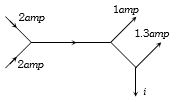
- 8The figure below shows currents in a part of electric circuit. The current $i$ is ............. $amp$View Solution
- 9Consider a metallic cube of edge length $L$. Its resistance, $R$, measured across its opposite faces is $R =\frac{ m _{ e } v }{ ne ^2 L ^2}$, where $n$ is the number density and $v$ is the drift speed of electrons in the cube, and $e$ and $m _{ e }$ are the charge and mass of an electron respectively. Assuming the de-Broglie wavelength of the electron to be $L$, the maximum resistance of the sample is closest to ............. $\,\Omega$ $\left(e=1.60 \times 10^{-19} \,C ; m _{ e }=9.11 \times 10^{-31} \,kg\right.$; Planck's constant, $h=6.63 \times 10^{-34} \,Js$ )View Solution
- 10The current flowing through a conductor connected across a source is $2\,A$ and $1.2\,A$ at $0^{\circ}\,C$ and $100^{\circ}\,C$ respectively. The current flowing through the conductor at $50^{\circ}\,C$ will be $......\times 10^2\,mA$.View Solution