A current of $5\; {A}$ is passing through a non-linear magnesium wire of cross-section $0.04\; {m}^{2}$. At every point the direction of current density is at an angle of $60^{\circ}$ with the unit vector of area of cross-section. The magnitude of electric field at every point of the conductor is ....${V} / {m}$ (Resistivity of magnesium is $\rho=44 \times 10^{-8}\, \Omega m$)
JEE MAIN 2021, Diffcult


Download our appand get started for free
Experience the future of education. Simply download our apps or reach out to us for more information. Let's shape the future of learning together!No signup needed.*
Similar Questions
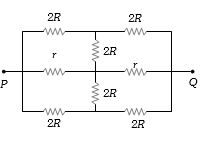
- 1The effective resistance between points $P$ and $Q$ of the electrical circuit shown in the figure isView Solution
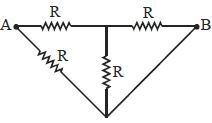
- 2Find equivalent resistance $A$ and $B$View Solution
- 3Four identical cells each having an electromotive force $(e.m.f.)$ of $12\,V$, are connected in parallel. The resultant electromotive force $(e.m.f.)$ of the combination is .............. $V$View Solution
- 4View SolutionTwo heating coils, one of fine wire and the other of thick wire of the same material and of the same length are connected in series and in parallel. Which of the following statement is correct
- 5For comparing the $e.m.f.$'s of two cells with a potentiometer, a standard cell is used to develop a potential gradient along the wires. Which of the following possibilities would make the experiment unsuccessfulView Solution
- 6View SolutionThe drift velocity does not depend upon
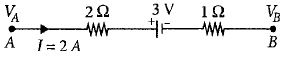
- 7The potential difference $(V_A - V_B)$ between the points $A$ and $B$ in the given figure is ............ $V$View Solution
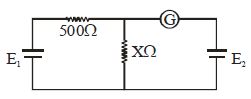
- 8In the adjoining circuit, the battery $E_1$ has an emf of $12\, volt$ and zero internal resistance while the battery $E_2$ has an $emf$ of $2\, volt$. If the galvanometer $G$ reads zero, then the value of the resistance $X$ (in $ohm$ ) isView Solution
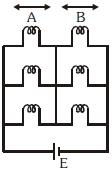
- 9Six similar bulbs are connected as shown in the figure with a $DC$ source of $emf\; E$, and zero internal resistance. The ratio of power consumption by the bulbs when $(i)$ all are glowing and $(ii)$ in the situation when two from section $A$ and one from section $B$ are glowing, will beView Solution
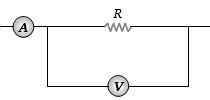
- 10The ammeter $A$ reads $2\, A$ and the voltmeter $V$ reads $20\, V$. the value of resistance $R$ is (Assuming finite resistance's of ammeter and voltmeter)View Solution