A curved in a level road has a radius $75\, m$. The maximum speed of a car turning this curved road can be $30 \,m / s$ without skidding. If radius of curved road is changed to $48\, m$ and the coefficient of friction between the tyres and the road remains same, then maximum allowed speed would be .........$m / s$.
JEE MAIN 2022, Medium


Download our appand get started for free
Experience the future of education. Simply download our apps or reach out to us for more information. Let's shape the future of learning together!No signup needed.*
Similar Questions
- 1A circular road of radius $1000 \,m$ has banking angle ${45^o}$. The maximum safe speed of a car having mass $2000 \,kg$ will be, if the coefficient of friction between tyre and road is $0.5$ ....... $m/s$View Solution
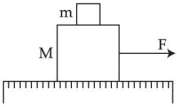
- 2A system of two blocks of masses $m =2 \; kg$ and $M=8 \; kg$ is placed on a smooth table as shown in figure. The coefficient of static friction between two blocks is $0.5$. The maximum horizontal force $F$ that can be applied to the block of mass $M$ so that the blocks move together will be $\dots \; N$View Solution
- 3A child weighing $25$ kg slides down a rope hanging from the branch of a tall tree. If the force of friction acting against him is $2\, N$, ........ $m/s^2$ is the acceleration of the child (Take $g = 9.8\,m/{s^2})$View Solution
- 4View SolutionWhich of the following is correct, when a person walks on a rough surface
- 5A heavy box is to dragged along a rough horizontal floor. To do so, person $A$ pushes it at an angle $30^o$ from the horizontal and requires a minimum force $F_A$, while person $B$ pulls the box at an angle $60^o$ from the horizontal and needs minimum force $F_B$. If the coefficient of friction between the box and the floor is $\frac{{\sqrt 3 }}{5}$ , the ratio $\frac{{{F_A}}}{{{F_B}}}$ isView Solution
- 6A gramophone record is revolving with an angular velocity $\omega$. A coin is placed at a distance $r$ from the centre of the record. The static coefficient of friction is $\mu .$ The coin will revolve with the record ifView Solution
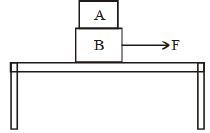
- 7Two blocks $A$ and $B$ of masses $m_A = 1\,kg$ and $m_B = 3\,kg$ are kept on the table as shown in figure. The coefficient of friction between $A$ and $B$ is $0.2$ and between $B$ and the surface of the table is also $0.2.$ The maximum force $F$ that can be applied on $B$ horizontal, so that the block $A$ does not slide over the block $B$ is ........ $N$. [Take $g = 10\,m/s^2$ ]View Solution
- 8View SolutionA motorcyclist of mass m is to negotiate a curve of radius r with a speed v. The minimum value of the coefficient of friction so that this negotiation may take place safely, is
- 9A bullet of mass $0.1\,kg$ moving horizontally with speed $400\,ms ^{-1}$ hits a wooden block of mass $3.9\,kg$ kept on a horizontal rough surface. The bullet gets embedded into the block and moves $20\,m$ before coming to rest. The coefficient of friction between the block and the surface is $........$ $\left(\text { Given } g=10 \,ms ^2\right. \text { ) }$View Solution
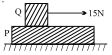
- 10$A$ long plank $P$ of the mass $5\, kg$ is placed on a smooth floor. On $P$ is placed a block $Q$ of mass $2\, kg$. The coefficient of friction between $P$ and $Q$ is $0.5$. If a horizontal force $15N$ is applied to $Q$, as shown, and you may take $g$ as $10N/kg.$View Solution