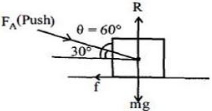
A heavy box is to dragged along a rough horizontal floor. To do so, person $A$ pushes it at an angle $30^o$ from the horizontal and requires a minimum force $F_A$, while person $B$ pulls the box at an angle $60^o$ from the horizontal and needs minimum force $F_B$. If the coefficient of friction between the box and the floor is $\frac{{\sqrt 3 }}{5}$ , the ratio $\frac{{{F_A}}}{{{F_B}}}$ is
JEE MAIN 2014, Difficult
Download our app for free and get started
${F_A} = \frac{{\mu mg}}{{\sin \theta - \mu \cos \theta }}$
similarly,
${F_B} = \frac{{\mu mg}}{{\sin \theta + \mu \cos \theta }}$
$\therefore \frac{{{F_A}}}{{{F_B}}} = \frac{{\frac{{\mu mg}}{{\sin \theta - \mu \cos \theta }}}}{{\frac{{\mu mg}}{{\sin \theta + \mu \cos \theta }}}}$
$ = \frac{{\sin {{60}^ \circ } - \frac{\mu mg$
$\sqrt 3
}{5}\cos {{60}^ \circ }}}{{\sin {{30}^ \circ } + \frac{\mu mg$
$\sqrt 3}{5}\cos {{30}^ \circ }}}$
$[ {\mu = \frac{{\sqrt 3 }}{5}}$ given $]$
$= \frac{{\sin {{30}^{ \circ }} + \frac{{\sqrt 3 }}{5} - \cos {{30}^ \circ }}}{{\sin {{60}^ \circ } - \frac{{\sqrt 3 }}{5}\cos {{60}^ \circ }}}$
$= \frac{{\frac{1}{2} + \frac{{\sqrt 3 }}{5} \times \frac{{\sqrt 3 }}{2}}}{{\frac{{\sqrt 3 }}{2} - \frac{{\sqrt 3 }}{5} \times \frac{1}{2}}}$
$= \frac{{\frac{1}{2}\left( {1 + \frac{3}{5}} \right)}}{{\frac{{\sqrt 3 }}{5}\left( {1 - \frac{1}{5}} \right)}} = \frac{{\frac{1}{2} \times \frac{8}{5}}}{{\frac{{\sqrt 3 \times 4}}{{10}}}}$
$= \frac{{\frac{8}{{10}}}}{{\frac{{\sqrt 3 \times 4}}{{10}}}}$
$= \frac{8}{{\sqrt 3 \times 4}}$
$= \frac{2}{{\sqrt 3 }}$
similarly,
${F_B} = \frac{{\mu mg}}{{\sin \theta + \mu \cos \theta }}$
$\therefore \frac{{{F_A}}}{{{F_B}}} = \frac{{\frac{{\mu mg}}{{\sin \theta - \mu \cos \theta }}}}{{\frac{{\mu mg}}{{\sin \theta + \mu \cos \theta }}}}$
$ = \frac{{\sin {{60}^ \circ } - \frac{\mu mg$
$\sqrt 3
}{5}\cos {{60}^ \circ }}}{{\sin {{30}^ \circ } + \frac{\mu mg$
$\sqrt 3}{5}\cos {{30}^ \circ }}}$
$[ {\mu = \frac{{\sqrt 3 }}{5}}$ given $]$
$= \frac{{\sin {{30}^{ \circ }} + \frac{{\sqrt 3 }}{5} - \cos {{30}^ \circ }}}{{\sin {{60}^ \circ } - \frac{{\sqrt 3 }}{5}\cos {{60}^ \circ }}}$
$= \frac{{\frac{1}{2} + \frac{{\sqrt 3 }}{5} \times \frac{{\sqrt 3 }}{2}}}{{\frac{{\sqrt 3 }}{2} - \frac{{\sqrt 3 }}{5} \times \frac{1}{2}}}$
$= \frac{{\frac{1}{2}\left( {1 + \frac{3}{5}} \right)}}{{\frac{{\sqrt 3 }}{5}\left( {1 - \frac{1}{5}} \right)}} = \frac{{\frac{1}{2} \times \frac{8}{5}}}{{\frac{{\sqrt 3 \times 4}}{{10}}}}$
$= \frac{{\frac{8}{{10}}}}{{\frac{{\sqrt 3 \times 4}}{{10}}}}$
$= \frac{8}{{\sqrt 3 \times 4}}$
$= \frac{2}{{\sqrt 3 }}$

Download our appand get started for free
Experience the future of education. Simply download our apps or reach out to us for more information. Let's shape the future of learning together!No signup needed.*
Similar Questions
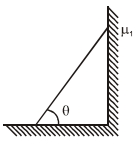
- 1In the figure, a ladder of mass $m$ is shown leaning against a wall. It is in static equilibrium making an angle $\theta$ with the horizontal floor. The coefficient of friction between the wall and the ladder is $\mu_1$ and that between the floor and the ladder is $\mu_2$. The normal reaction of the wall on the ladder is $N_1$ and that of the floor is $N_2$. If the ladder is about to slip, thenView Solution
$Image$
$(A)$ $\mu_1=0 \mu_2 \neq 0$ and $N _2 \tan \theta=\frac{ mg }{2}$
$(B)$ $\mu_1 \neq 0 \mu_2=0$ and $N_1 \tan \theta=\frac{m g}{2}$
$(C)$ $\mu_1 \neq 0 \mu_2 \neq 0$ and $N _2 \tan \theta=\frac{ mg }{1+\mu_1 \mu_2}$
$(D)$ $\mu_1=0 \mu_2 \neq 0$ and $N _1 \tan \theta=\frac{ mg }{2}$
- 2A block is kept on an inclined plane of inclination $\theta$ of length l. The velocity of particle at the bottom of inclined is (the coefficient of friction is $\mu$)View Solution
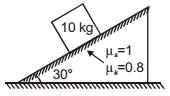
- 3A block of $10 \,kg$ mass is placed on a rough inclined surface as shown in figure. The acceleration of the block will beView Solution
- 4View SolutionA motorcyclist of mass m is to negotiate a curve of radius r with a speed v. The minimum value of the coefficient of friction so that this negotiation may take place safely, is
- 5View SolutionWhen two surfaces are coated with a lubricant, then they
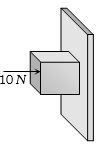
- 6A horizontal force of $10 \,N$ is necessary to just hold a block stationary against a wall. The coefficient of friction between the block and the wall is $0.2$. the weight of the block is ........ $N$View Solution
- 7Pulling force making an angle $\theta $ to the horizontal is applied on a block of weight $W$ placed on a horizontal table. If the angle of friction is $\alpha $, then the magnitude of force required to move the body is equal toView Solution
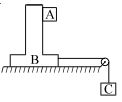
- 8In the arrangement shown in the figure, mass of the block $B$ and $A$ is $2m$ and $m$ respectively. Surface between $B$ and floor is smooth. The block $B$ is connected to the block $C$ by means of a string pulley system. If the whole system is released, then find the minimum value of mass of block $C$ so that block $A$ remains stationary $w.r.t. B$. Coefficient of friction between $A$ and $B$ is $\mu$View Solution
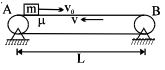
- 9With what minimum velocity should block be projected from left end $A$ towards end $B$ such that it reaches the other end $B$ of conveyer belt moving with constant velocity $v$. Friction coefficient between block and belt is $\mu$ .View Solution
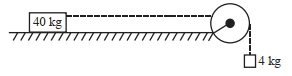
- 10A block of mass $40 \,kg$ slides over a surface, when a mass of $4 \,kg$ is suspended through an inextensible massless string passing over frictionless pulley as shown below. The coefficient of kinetic friction between the surface and block is $0.02$. The acceleration of block is ............ $ms ^{-2}$ (Given $g =10 \,ms ^{-2}$.)View Solution