MCQ
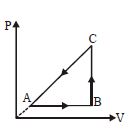
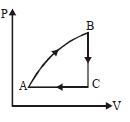
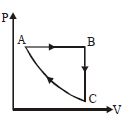
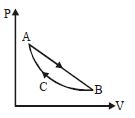
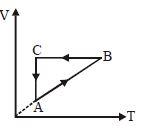
A cyclic process $ABCA$ is  shown in the $V-T$ diagram. Process on the $P-V$ diagram is
  • A

  • B


  • D

Answer

Correct option: C.

c
The process $A B$ is isobaric since it is an inclined straight line in the $V-T$ diagram.

The process $\mathrm{BC}$ is an isochoric process since the volume is constant

The process $\mathrm{CA}$ is isothermal since, temperature remains constant.

The only $P-v$ graph that matches the above criteria is option $\mathrm{C}$

Need a full question paper?

Generate a complete, print-ready paper with questions like this in minutes — across 16+ boards, with answer keys.

Start Generating Free

Similar questions

$Assertion$ : In a free fall, weight of a body becomes effectively zero.

$Reason$ : Acceleration due to gravity acting on a body having free fall is zero.
A man is standing at a spring platform. Reading of spring balance is $60\, kg$ wt. If man jumps outside platform, then reading of spring balance
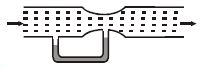
Water flows through the tube shown. Area of cross-section of wide and narrow part are $5$ $cm^2$ $\&$ $2$ $cm^2$. The rate of flow is $500$ $cm^3/sec$. Find difference in mercury level of $U-$ tube .......... $cm$
The velocity $v$ (in $cm/\sec $) of a particle is given in terms of time $t$ (in sec) by the relation $v = at + \frac{b}{{t + c}}$ ; the dimensions of $a,\,b$ and $c$ are
A particle of mass m is executing oscillations about the origin on the $X-$axis. Its potential energy is $U(x) = k{[x]^3}$, where $k$ is a positive constant. If the amplitude of oscillation is $a$, then its time period $T$ is
Water falls from a height of $210\,m.$ Assuming whole of energy due to fall is converted into heat the rise in temperature of water would be   .......... $^oC$  $(J = 4.3 \,Joule/cal)$
An air bubble of radius $r$ rises steadily through a liquid of density $\rho $ with velocity $v$ . The coefficient of viscosity of liquid is
A cylindrical vessel filled with water upto height of $H$ stands on a horizontal plane. The side wall of the vessel has a plugged circular hole touching the bottom. The coefficient of friction between the bottom of vessel and plane is $\mu$ and total mass of water plus vessel is $M$. What should be minimum diameter of hole so that the vessel begins to move on the floor if plug is removed (here density of water is $\rho$ )
An arrow is shot into air. Its range is $200\,m$ and its time of flight is $5\,s$. If $g=10\,m / s ^2$, then horizontal component of velocity and the maximum height will be respectively
The two ends of a spring are displaced along the length of the spring. All displacements have equal magnitudes. In which case or cases the tension of compression in the spring will have a maximum magnitude?